
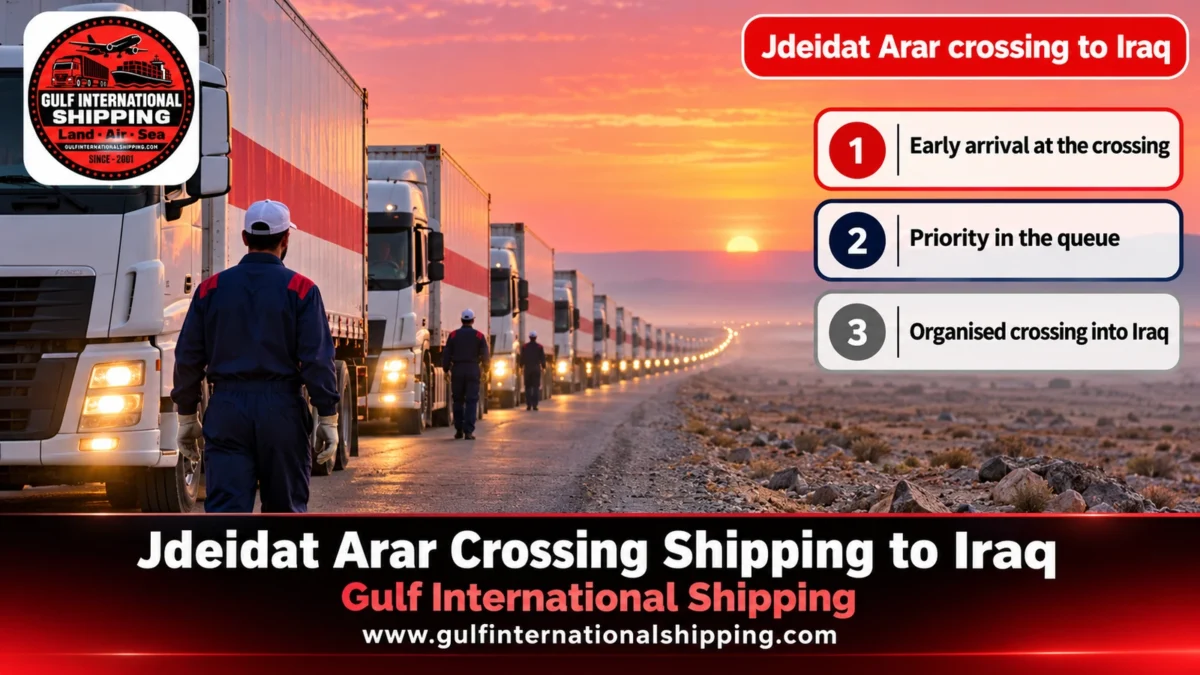
The Jdeidat Arar border crossing is Saudi Arabia’s land port on the Iraqi frontier. Some 70 km north of Arar city, opposite the Iraqi post of the same name on the Anbar side close to Nukhayb, it runs around the clock, and handles almost every road shipment from the Kingdom to Iraq. Loads are usually transferred there from a Saudi truck to an Iraqi one inside a fenced exchange yard. In this guide Gulf International Shipping explains how the crossing works step by step, which papers it asks for, and what holds trucks up and how to avoid it. If you just want a number: sending a carton via Arar starts at SAR 137 with us and a bedroom suite at SAR 2,300, and takes about 4–6 working days from Riyadh to Baghdad.
It is written for anyone who wants to understand the route before booking: the expatriate employee preparing to go home to Iraq, the trader sending stock for the first time, or the person who has heard that loads “get stuck at the border” and wants to know why. You will find facts about the crossing itself, what happens on each side, the truck’s onward journey into the western desert, and the mistakes customers keep making.
In short
- Location: roughly 70 km north of Arar, and some 1,100 km by road from Dammam
- Facing post: Iraq’s Arar crossing in Anbar; the nearest town is Nukhayb, with the road on to Karbala and Najaf
- Hours: around the clock, seven days a week, busier in the Hajj and Umrah seasons
- Capacity: designed for about 500 trucks a day, with parking for about 500 trucks and some 600 m² of storage
- How goods cross: trucks from both countries stop in the exchange yard and only the cargo moves across
- Clearance time: usually a few hours to a working day, longer around holidays and peak seasons
- Shipping prices via Arar: unaffected by the crossing itself; the floor is SAR 137 for one carton and a whole truck begins at SAR 5,980
Crossing: Jdeidat Arar (Saudi) ↔ Arar (Iraq) · Open: 24 hours · Call: 0568829975
Where is the Jdeidat Arar crossing, and what is the post on the Iraqi side?
Jdeidat Arar lies north of Arar, the capital of the Northern Borders Region, about an hour and a quarter away by truck. Opposite it is Iraq’s Arar crossing, in the Rutba area of Anbar Governorate, and the nearest settlement is Nukhayb, deep in the western desert. Because the two posts share almost the same name, people often mix up Saudi “Jdeidat Arar” and Iraqi “Arar”; they are simply the two facing ends of one crossing.
What makes the location so useful is that it opens a direct road from the heart of the Kingdom to the Middle Euphrates. Past Nukhayb, the highway descends towards Karbala and Najaf, which in turn connect to Baghdad, Hilla and Diwaniyah. In other words, the closest big Iraqi cities to the border are Karbala and Najaf, not Baghdad as many assume.
The crossing’s story: how it became the main freight route to Iraq
The Arar crossing stayed shut to trade for roughly thirty years, and in that time Saudi goods bound for Iraq had to loop through Jordan or Kuwait, adding distance and paperwork. Once it reopened for trade, the picture changed: road freight had a direct line again, and the post was later opened to Umrah travellers too. Figures published by the Arar Chamber of Commerce show truck movements jumping from about 4,000 in the first half of its first full year of operation to roughly 33,000 in a later half-year, a manifold increase within a few years.
Press reports say food makes up the largest share of Saudi exports to Iraq, followed by building materials. For you as a customer, that means sharing the road with heavy commercial traffic, and a pre-booked slot plus a complete file are what let your truck through without a long wait.
Is the Arar crossing open 24 hours?
Yes. There is no closing hour at Jdeidat Arar, and holidays do not shut it either. But “always open” is not the same as “no waiting”. Pressure builds at certain times, above all in the Hajj and Umrah seasons when coachloads of travellers pass through, and on public holidays when administrative staff are thinner on both sides. So in our planning we allow a few hours, sometimes a full working day, at the border, and we flag it early if your date clashes with a rush.
The best time to load
If your shipment is not urgent, ask for the truck to reach the border away from the Hajj and Umrah peaks and the start of public holidays. Two days of planning can save a full day of queueing.
How do goods cross at Arar? The exchange yard step by step
The defining feature of Arar is that goods cross while trucks stay put. The Saudi truck pulls into a fenced yard, an Iraqi truck draws up beside it, the load moves from one to the other, and each driver returns home. The practice rests on long-standing Iraqi instructions governing foreign commercial vehicles, which require transport firms to use Iraqi trucks for part of their work. These are the stages as Gulf International Shipping’s team follows them:
- 1Arrival on the booked slot
The Saudi truck arrives within the window registered on Fasah and its export data is checked. - 2Saudi-side inspection
The declaration is matched against the load; some cartons may be opened or the truck X-rayed. - 3Into the exchange yard
The truck parks beside the Iraqi truck reserved for it in advance. - 4Truck-to-truck transfer
The crew unloads and restows every item in the same order, photographs the load before and after, and ticks the carton numbers off the list. - 5Iraqi-side declaration
An Iraqi customs agent keys in the import entry, and duty is computed from the real price on your receipts. - 6Examination and release
Iraqi customs examine what they ask to see, duty is paid and the load is released. - 7Off towards Nukhayb
The Iraqi truck leaves the crossing for Karbala and Najaf, then your city.
What about TIR?
Iraq has joined the TIR international transit system, and trial runs through Arar have been made without transferring cargo between trucks, operated by Iraqi carriers. These direct trips may be available for some commercial consignments, but they are not the normal way furniture and personal belongings travel, so we plan around the exchange yard and tell you if your commercial load qualifies for anything else.
The Fasah slot: the step before the border
ZATCA requires every truck to book an appointment on the Fasah platform before it arrives at any land port, and to turn up within a time window around that slot. A truck that arrives without a booking, or outside its window, can be sent back into the queue. Before the slot, the export declaration must be filed and the shipment data must match what is actually in the truck.
At Gulf International Shipping we file the declaration and book the slot ourselves once the truck is sealed in your city, and we time the drive from Riyadh, Jeddah or Dammam so the truck arrives inside its window, not a day early or hours late. Customers never need to log in to the platform or go to the border.
Documents required at the Arar crossing
Paperwork at the crossing comes in two kinds: what the Saudi side needs for export and what the Iraqi side needs for the import declaration. A missing page of the second kind is the most common reason an Iraqi truck sits idle after the transfer.
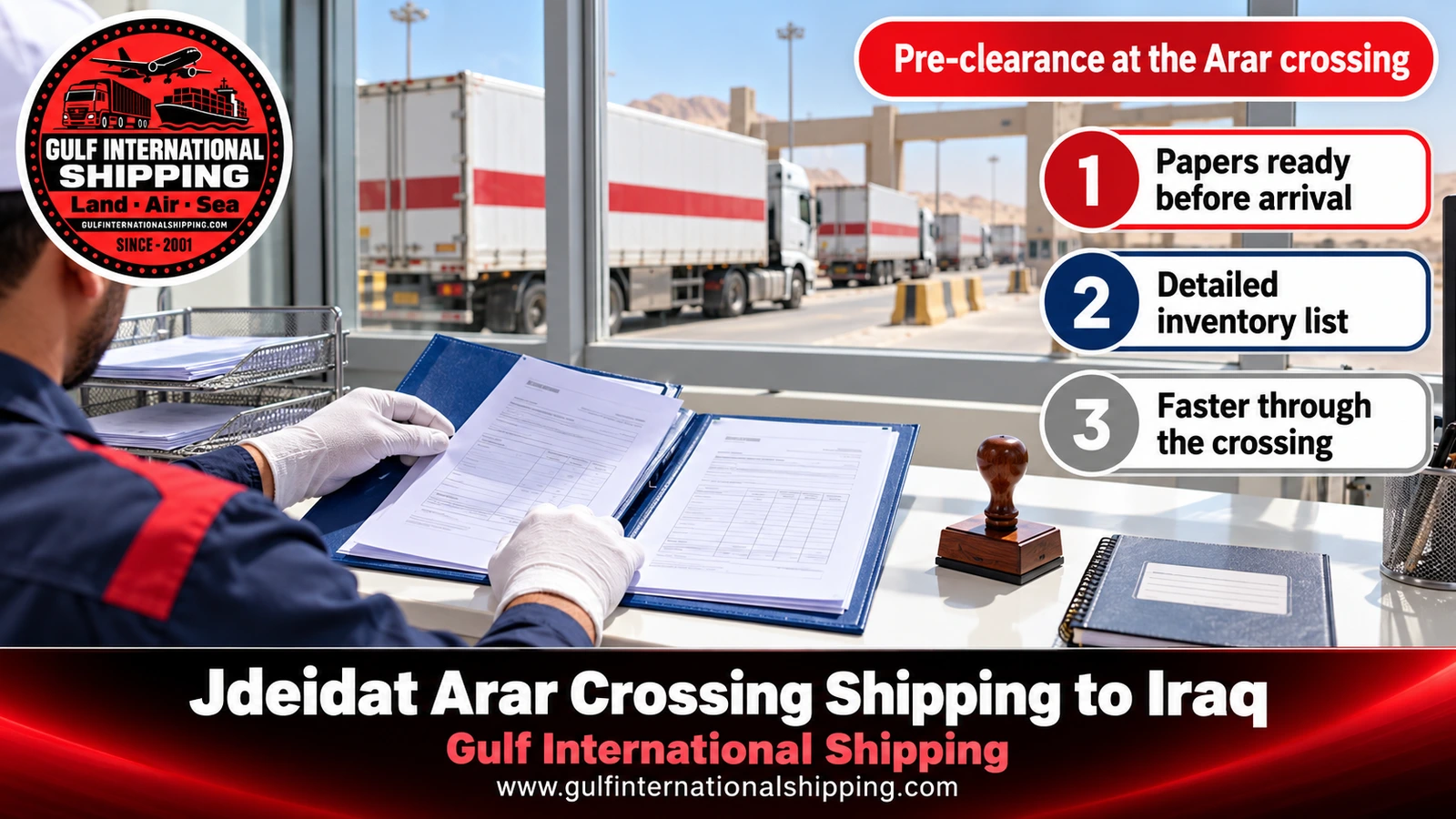
There is no special “pre-registration” step for household goods at Arar, whatever some adverts say. Still, a file that is complete before loading works as pre-clearance in practice: the broker reaches the yard with every paper ready and starts the declaration the moment the transfer ends.
After the border: the road from Arar to Karbala, Najaf and Baghdad
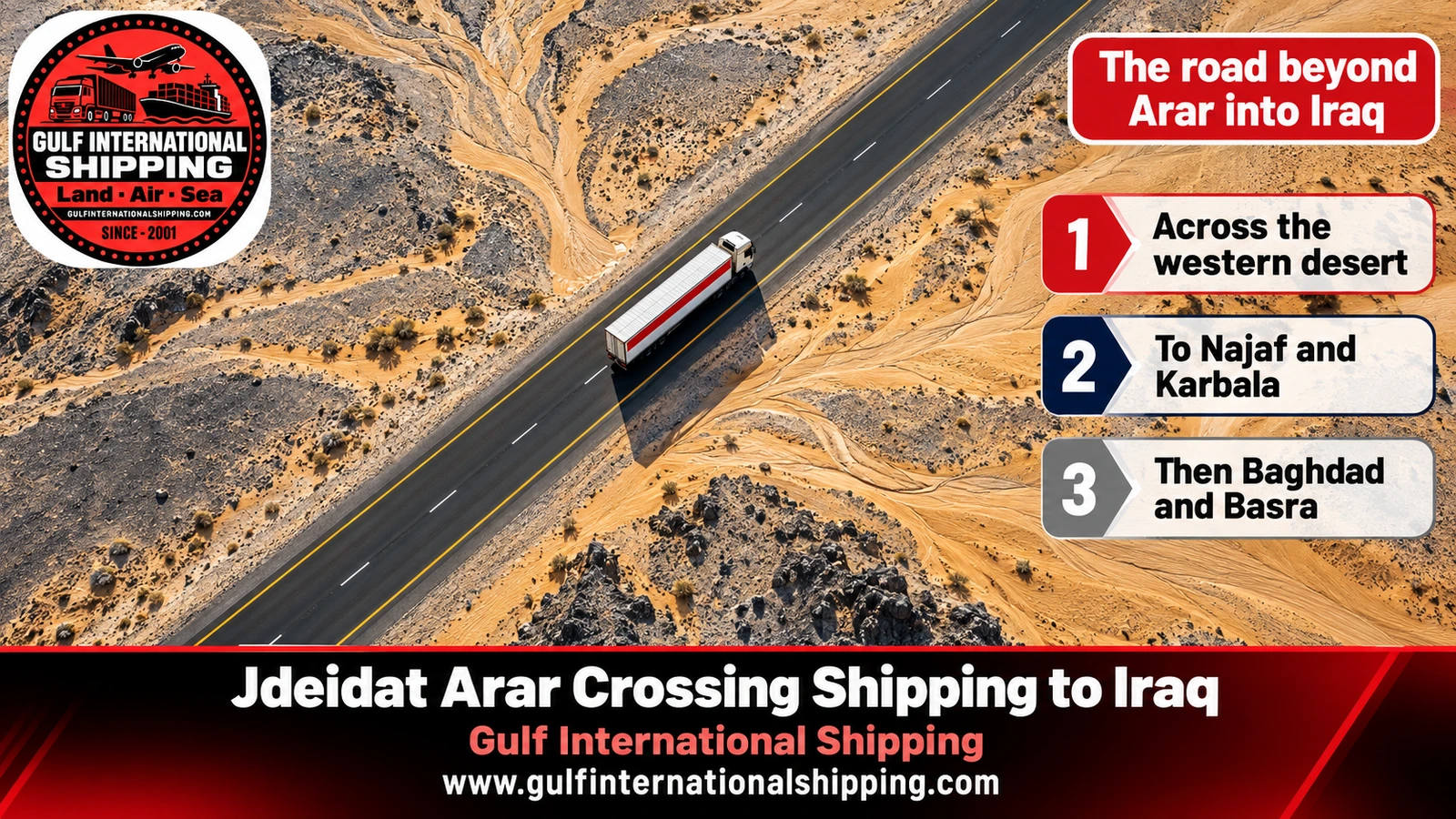
Once released, the Iraqi truck sets off across the western desert on a long, almost straight road to Nukhayb, then drops east to Karbala and Najaf. From there the roads branch: north to Baghdad; south to Diwaniyah, Samawah, Nasiriyah and Basra; and from Baghdad further north to Samarra, Kirkuk, Mosul and the Kurdistan Region.
Are there other crossings from Saudi Arabia to Iraq?
Jdeidat Arar is the only direct land crossing operating between the two countries today. Iraq does have other crossings with Kuwait (Safwan) and Jordan (Trebil), and a Saudi load could in theory transit one of those countries, but that means two borders instead of one, extra transit formalities and a longer drive. So Arar stays our main route, and we only use the others for special cases after studying the shipment.
Wrong crossing names that keep appearing in adverts
Ignore any advert that mentions the Nassib crossing for Iraq; Nassib links Jordan and Syria. Al-Haditha, Halat Ammar and Al-Durra are not Iraq crossings either; they are Saudi posts on the Jordanian border. Abdali is a Kuwait–Iraq crossing, not a Saudi one. And the road from Riyadh to Arar does not normally run through Hafar Al-Batin, but through Qassim, Hail and Rafha.
Why trucks get delayed at Arar, and how to avoid it
Most of the delays we see come not from the crossing itself but from the shipment file. These are the usual suspects:
- A vague inventory: a line like “household goods” prompts customs to open everything. List each carton by number and contents.
- Mismatched names: the owner’s name differs by a letter between passport, inventory and export declaration.
- New appliances without invoices: their value gets estimated, sometimes above the real figure.
- Hidden banned or restricted items: walkie-talkies, a drone, unapproved medicines or decorative knives.
- An ineligible car: an older model heading to Kurdistan, or a car previously flood- or fire-damaged.
- The recipient’s phone switched off: the broker needs to reach the recipient during the declaration.
- Missing the Fasah window: because of late loading or a badly timed drive.
Do you need to go to the Arar crossing yourself?
No. When you ship with Gulf International Shipping, our representative oversees the transfer in the exchange yard and a licensed broker handles the Iraqi declaration. You are responsible for two things: making sure your papers are correct and complete before loading, and keeping your phone and the recipient’s phone on to answer any question. If you are travelling through the crossing yourself, note that the passenger lane is separate from the truck yard, so you do not need to meet your shipment there.
Air freight: the alternative for urgent loads
Some consignments never need the border at all: important papers your son left behind, a licensed medicine, a small valuable gadget. We put those on a plane from Jeddah, Dammam or Madinah to one of Iraq’s four main airports, on whatever flights are scheduled that day, and they land within two to four days. Air starts at SAR 41 a kilo, about three times the road rate, so furniture and volume stay on the truck.
How much does shipping via the Arar crossing cost?
Using Arar adds nothing to the bill; what you send decides it. Here are four opening prices for road freight via Arar with Gulf International Shipping, with the remainder in shipping prices from Saudi Arabia to Iraq:
Note: trucks normally arrive in 4–7 working days from loading; Iraqi duties are extra and settled when the goods are declared.
Want your shipment through Arar without delays?
Send us your list, your Saudi city and the Iraqi destination; we will review your file and set the right loading date.
Related Iraq guides
- The whole journey: land freight from Saudi Arabia to Iraq
- What you pay by shipment: shipping prices from Saudi Arabia to Iraq
- Returnee paperwork and limits: Iraq used household goods customs
- Your car at the border: car shipping from Saudi Arabia to Iraq
- Families leaving for good: furniture moving from Saudi Arabia to Iraq
- customs clearance · land freight · air freight · destinations from the Kingdom