


Think of Gulf International Shipping as the shipping company from Saudi Arabia to Turkey that handles the whole chain: our crews collect household furniture, boxes, merchandise and vehicles from any Saudi city and stow them into a container at Jeddah Islamic Port; the ship heads north past Suez to Mersin, İskenderun or one of the Marmara ports near Istanbul, and we clear the cargo and bring it to your Turkish address. Anything urgent goes on scheduled flights to Istanbul from the airports of Jeddah, Riyadh, Dammam and Madinah. The voyage from Jeddah to Mersin is about 5 days. A full container is at the door in roughly 14–20 days in southern Turkey and 18–28 days in Istanbul and Bursa, and a parcel sent by plane is in Istanbul within 3–5 working days. Entry-level prices are SAR 110 for anything up to 5 kg, SAR 14 a kilo on a plane, SAR 410 per cubic metre of shared container space, SAR 920 for a full bedroom set, a private twenty-foot box at SAR 4,140, and SAR 5,060 for a car that satisfies Turkish customs.
Most callers open with the same two questions: how many days, and how many riyals? The honest answer depends on three things that most advertisers never mention. First, the Turkish city you are moving to, because each region of Turkey is served by a different port. Second, who you are in the eyes of Turkish customs: a Turkish citizen returning home, an Arab resident holding a Turkish residence permit, or someone simply sending things. Third, the volume, which decides whether you share a container or book one in your own name. This page answers all three with figures, then walks through prices, paperwork, banned items, car rules and the booking steps.
Quick facts
- Transport: sea containers out of Jeddah, plus flights to Istanbul for urgent items; we offer sea and air to Turkey, nothing else
- Sailing: one departure a week, with Mersin about five days out and İskenderun about eight
- Container to the door: from the Hijaz: southern Turkey in 14–20 days, Ankara and Antalya in 16–22, Istanbul, Bursa and İzmir in 18–28, Trabzon in 21–30
- By air: Istanbul in 3–5 working days, other major cities in 4–6 working days
- Lowest prices: SAR 110 a parcel, SAR 14 per air kilo, SAR 410 per shared cubic metre, SAR 4,140 for a whole 20 ft box
- Your used furniture: enters duty-free for a returning Turkish citizen who meets the conditions, and for a settled foreigner holding an ikamet, a tax office number and a notary-stamped lease
- Your car: wrapped and boxed in a closed container when it qualifies under Turkish rules; SAR 5,060 and up, Turkish taxes extra
Path: Saudi home → Jeddah → Suez → Mersin or Marmara → Turkish home · Call or WhatsApp 0568829975
Which Turkish port will your shipment use? It depends on your destination city
The first thing we ask when you book a move to Turkey is the city where you will receive it. That is not paperwork for its own sake: the city tells us which port the container should be discharged at, and the port drives both the transit time and the cost. Turkey has a Mediterranean coast in the south, the Aegean in the west, the Sea of Marmara in the north-west and the Black Sea in the north, and each large port feeds its own cluster of cities. A container bound for Ankara, for instance, has no reason to go anywhere near Istanbul; its shortest path is Mersin followed by about 500 km of road north.
The table shows the port Gulf International Shipping uses for each Turkish region, the cities it serves and how the goods complete the journey:
Notice that the southern cities of Mersin, Adana and Gaziantep are the quickest and cheapest to reach, because the box comes off the ship there after about five days at sea. Istanbul, Bursa, Yalova and Sakarya, where most of our Arab customers in Turkey actually live, take longer, since the voyage to the Sea of Marmara is longer and may involve a hub port on the way. Trabzon and Uzungöl on the Black Sea are usually the furthest point we serve, reached by truck from the Marmara ports.
If you do not yet know which district you will live in, the city is enough for us to plan. A container can also wait a few days at the port or a nearby warehouse until your flat is ready, but budget for that from the start, because storage days at Turkish ports are charged to the shipment.

Route details and shipping time from Saudi Arabia to Turkey
The time you wait is made of five links in a chain: packing and preparing the goods in your city; trucking them to Jeddah, filing the export declaration on the Fasah platform and handing the container in before the booking cut-off; the voyage; clearance at the Turkish port; and the inland leg to the door. The sea leg itself is fairly short. What stretches the total is waiting for the weekly sailing and Turkish customs clearance, which normally takes 4–5 working days for household goods.
- Jeddah to Mersin at sea: about 5 days on a weekly line linking Jeddah with southern Turkey.
- Jeddah to İskenderun: about 8 days on the same line.
- Istanbul, the Marmara ports and İzmir: longer, because they are served by other lines or by transshipment.
- Turkish customs clearance: roughly 4–5 working days for used household goods when the file is complete.
- Air freight: 3–5 working days to Istanbul, covering the flight, clearance and delivery.
These are the approximate door-to-door times for a full container, split by Turkish region and by the Saudi city where it is loaded:
The figures are estimates and can move by a few days either way with the sailing schedule and how quickly the Turkish port releases the cargo. If you choose a shared container instead of a full one, add 5–7 days: a shared box stays open until enough customers have filled it, and then it waits for the next weekly vessel. If you need your things within a week, the answer is air, even though it costs more per kilo.
A quick rule for estimating your time
Take the lower figure for your Turkish region in the Hijaz column, then add one day from Madinah, two to three days from Riyadh, Qassim or Tabuk, and three to four days from the Eastern Province. That is the most realistic estimate before we confirm your vessel.
Why do all our Turkey shipments sail from Jeddah Islamic Port?
Turkey lies north of the Red Sea, and the sea road to it runs through the Suez Canal and across the eastern Mediterranean. That makes Jeddah Islamic Port our natural gateway: the weekly services to southern Turkey leave from there, and the voyage is as short as it can be. Sailing from a port on the Arabian Gulf would mean going all the way round the Arabian Peninsula before reaching Suez, adding weeks. So Gulf International Shipping sends every Turkey container from Jeddah, and trucks loads from Riyadh, the Eastern Province, Tabuk and Qassim to Jeddah first.
For a customer in Dammam this means there is no need to hunt for a vessel out of Dammam port. Our closed truck collects from homes in Dammam, Khobar and Dhahran, or in Jubail, Qatif and Al-Ahsa, drives about 1,400 km to Jeddah and the container is loaded there. From Riyadh the truck covers about 950 km. Before confirming any booking we review shipping conditions in the Red Sea and tell you the confirmed sailing date before your things leave home.
Adverts for “overland shipping to Turkey”
Some adverts talk about trucks driving from the Kingdom straight to Turkey. That road crosses several countries and the load has to be moved onto another truck at the Syrian border, so we have chosen not to sell it and to rely on ships and aircraft. Before paying anyone, ask three things: where the box sails from, where it lands in Turkey, and on which date.
Approximate costs of shipping from Saudi Arabia to Turkey
We set the entry figures in this table after reviewing what shipping companies to Turkey publish in each Saudi city, and set our own figure a little under the cheapest advertised rate for that same item. The figure covers transport from the loading city to Turkey with standard packing. It does not include what Turkish customs collects in duty and VAT on new items, trade goods and cars, which is paid to customs directly.
Note: a full container takes roughly 14–34 days door to door, depending on the Saudi loading city and the Turkish destination; a shared container is 5–7 days slower; flights deliver to Istanbul within 3–5 working days.
Entry prices for single items
If you are sending one or two pieces rather than a household, here is the price of each item travelling on its own in a shared container:
Jeddah is the cheapest starting point, followed by Makkah, because both sit next to the port. Prices rise slightly for Riyadh and Tabuk, and more for the Eastern Province, in line with the road distance to Jeddah. On the Turkish side, delivery to Ankara and Trabzon costs more than to Mersin or Istanbul. Each Saudi city has its own table in its article, and they sit side by side on one page, shipping prices from Saudi Arabia to Turkey, so the gap between cities is easy to see. Send us photos of your things and your Turkish city and we will reply with figures.
Shared container (LCL) or full container (FCL) to Turkey?
With a shared or LCL shipment your goods occupy part of a container that also carries other customers’ cargo for Turkey, and you pay only for the cubic metres you use. It suits students, small families and anyone sending a room or two with some cartons: instead of paying for a whole box you pay from SAR 410 per cubic metre. Its only drawback is that it is five to seven days slower, because the container is consolidated at our Jeddah warehouse and then unpacked and sorted at the Turkish port before delivery.
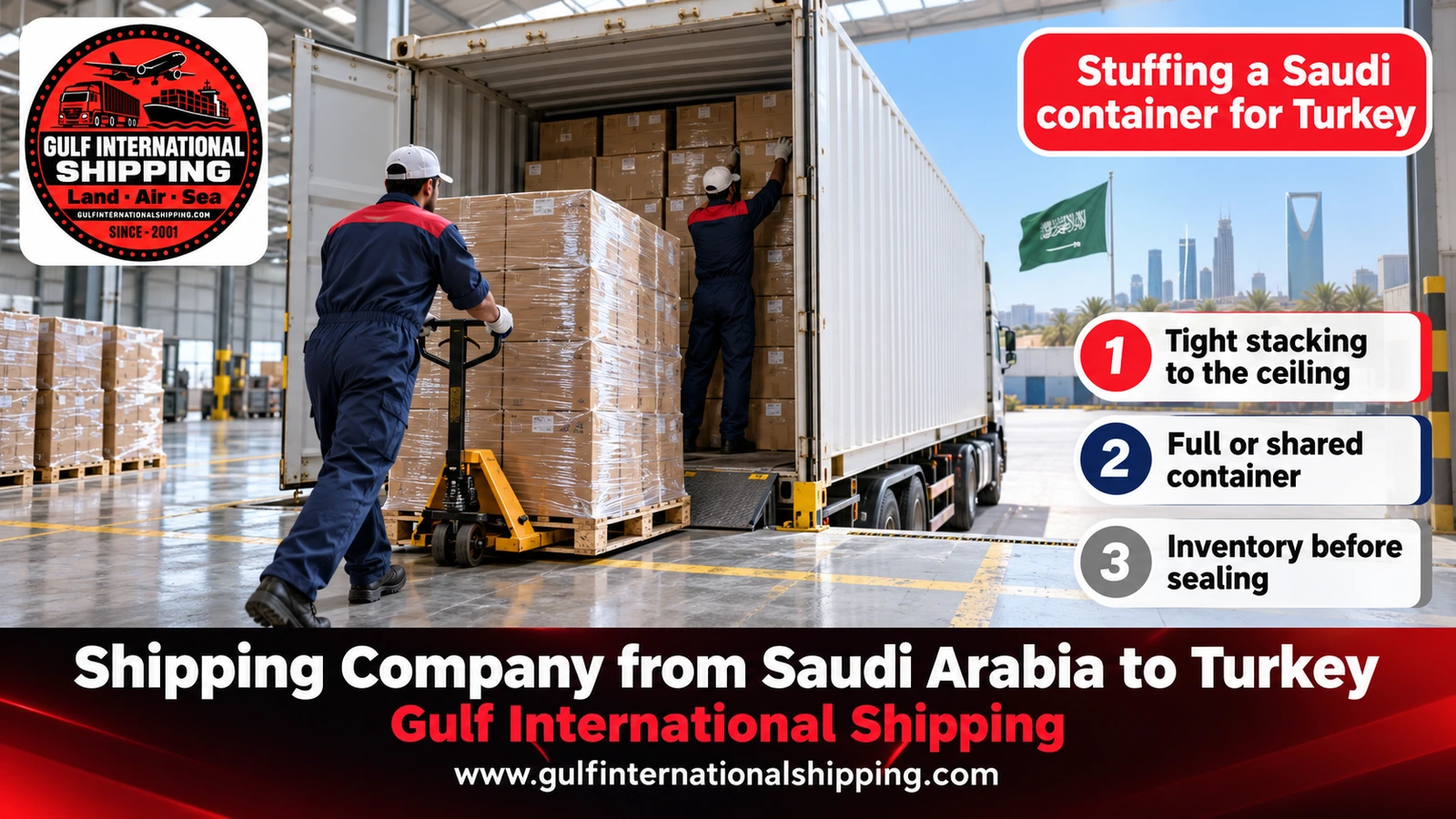
A full or FCL container is booked in your name alone. It is stuffed outside your home or at our warehouse, then sealed so that nobody opens it before the inspection in Turkey. The 20 ft size, from SAR 4,140, usually holds the contents of a two- or three-bedroom flat; the 40 ft size, from SAR 6,440, is for a villa or for anyone adding a car to their furniture. Once your goods pass roughly ten cubic metres the price gap between the two options becomes small, and we recommend the full container because it is faster and your things are handled less.
What do Turkish customs require? It depends on who you are
This is the part most Turkey shipping pages skip, even though it decides whether you pay duty on your furniture. Turkish customs look not only at the shipment but at its owner: a Turkish citizen moving residence back home, a foreigner settling in Turkey with a residence or work permit, or a person sending goods or gifts without moving. In every case the relief applies only to used belongings. New things are charged duty by tariff heading, then 20% VAT on top.
A Turkish citizen living in the Kingdom obtains the relocation certificate, the ikamet nakil belgesi, as issued by Turkey’s embassy in Riyadh or its consulate general in Jeddah. It goes with an itemised list showing appliance brands and serial numbers, the entry and exit record from Turkey’s e-Devlet portal, and a notary-certified mandate allowing the port broker to act for you. A follow-up consignment may come within the same six months, provided it brings nothing already declared. No customs duty is due on used furniture, though TV and radio sets attract the broadcasting fee known as the bandrol.
An Arab resident with a Turkish residence permit needs a Turkish tax number, easily obtained from the tax office, and either a lease notarised for a year or longer or a property title deed. With these, used furniture enters on a permanent basis; without them it can come in temporarily against a bank deposit or security bond, or on payment of the taxes. In every case the owner is expected to attend clearance in person. Both situations are covered step by step in our guide to Turkey used household goods customs, and the conditions are confirmed before shipping because they can change.
Ask yourself before you buy
If you plan to buy new appliances before leaving and take them to Turkey, remember that customs regard anything still in its shop packaging as new, and duplicates beyond what a household needs become dutiable. It is usually cheaper to ship what you already use and buy new in Turkey.
Moving furniture and household goods from Saudi Arabia to Turkey
Furniture heading for Turkey spends two to three weeks shut in a container, crossing the heat of the Red Sea before meeting the damp Mediterranean air, so it gets tougher packing than a local move. Our team begins with a survey of the home or of your photos, dismantles beds, wardrobes and kitchens, and wraps each piece in layers: bubble wrap against knocks, corrugated board on the corners, then a plastic outer skin against moisture. Glass and antiques go into wooden crates, and every carton is numbered and marked with the room it came from so that unpacking in the new home is straightforward.
We also photograph every electrical appliance together with the plate showing its brand and serial number, because Turkish customs match those details against the list filed with the exemption request. Inside the container heavy items go at the bottom, and everything is strapped and braced with timber so it cannot shift as the ship moves. In Turkey the delivery crew removes the packing and puts the beds and wardrobes back together. Households and returnees will find that furniture moving from Saudi Arabia to Turkey matches flat sizes to container sizes.
Car shipping from Saudi Arabia to Turkey: who qualifies?
A car can go to Turkey with us once it satisfies Turkish customs. A Turkish citizen moving back for good may import one passenger car whose model year makes it 3 years old or newer, which has been registered to them in their country of residence for 6 months or more before their latest arrival in Turkey, and which is declared within 6 months of that arrival; the right comes round once in 5 years. Foreign residents receive temporary admission only, lasting while their residence or work permit is valid. Many advertisers ignore this: importing used cars into Turkey is restricted and is not open to anyone who simply wants to.
Even when a returning citizen is exempt from customs duty on the car, the special consumption tax known as ÖTV and VAT are still payable. ÖTV grows with engine size and the car’s value, and on big engines it may end up larger than what the car is worth, so we ask you to check the amount before deciding to ship. These cars are processed only at designated customs offices in Istanbul, Gebze, İzmir and Ankara.
On the Saudi side we handle the export: export plates through Absher, settled traffic fines, a valid registration, release of any finance lien, and the export declaration on Fasah. The car is wrapped, strapped and chocked inside a closed container at Jeddah, and shipping starts at SAR 5,060, Turkish taxes being payable on arrival. Aircraft and ro-ro ships are not part of our car service to Turkey. For special cases and for foreigners, car shipping from Saudi Arabia to Turkey, which also sets out the ÖTV bands that drive the final bill.
Shipping cartons, parcels and personal belongings to Turkey
Cartons are what we send to Turkey most often: clothes for children studying there, gifts for family, books, and the belongings of relatives who have already moved to Istanbul. Being small, they travel in a shared container by sea when there is no rush, or by air when there is. We charge SAR 110 and up for anything to 5 kg, SAR 230 and up from 5 to 10 kg, and SAR 276 and up for a personal box weighing 10–20 kg.
Two points matter with parcels. First, a duty-paid postal or courier parcel may not exceed 30 kg gross and must be for personal, not commercial, use; above that it becomes ordinary cargo with full clearance. Second, mobile phones are not accepted in postal or courier parcels to Turkey, whether duty-free or duty-paid, so keep your phone in your hand luggage when you travel rather than in a carton. Weight bands: cartons and parcels shipping to Turkey lists them all.
Commercial cargo and online-store shipments to Turkey
For traders and factories we ship goods by full container or as part loads, with shared-container goods of 50 to 300 kg from SAR 1,100. A commercial shipment needs a certificate of origin, an invoice showing the value, and a packing list with weights, plus the Turkish importer’s tax number, because the importer clears the goods in their own name. Goods pay customs duty under their Turkish tariff line, then 20% VAT.
If you sell online to customers in Turkey, note that Presidential Decision 10813 ended the simplified regime for e-commerce parcels, which now go through normal import procedures; we therefore prefer to group your orders into one consignment cleared once. Dates and foodstuffs need specific approvals and suitable packing, and we tell you what applies before you book. Store owners: goods shipping from Saudi Arabia to Turkey also explains tariff lines and reefer containers.
Air freight from Saudi Arabia to Turkey
We turn to aircraft when urgency outweighs saving: official papers, prescribed medicines, a student’s things a few days before term, or trade samples. Parcels ride in the hold of the scheduled passenger flights between the Kingdom and Istanbul. Our air rate opens at SAR 14 per kilo; a shipment to Istanbul takes 3–5 working days including the flight, clearance and delivery; Ankara, İzmir, Antalya, Trabzon and Bursa need roughly one more day, so 4–6 working days.
For air cargo, lithium batteries are removed from devices or shipped under their own rules, cosmetics are not accepted in bulk, and you pay on the greater of the real weight and the volumetric weight. That is why air rarely suits large furniture, however light. Flight options and cargo limits: air freight from Saudi Arabia to Turkey sets them out.

Documents required for shipping to Turkey
The paperwork varies with the type of shipment and the owner’s status, and we send you the list for your case when you book. The table sums up the essentials:
Write your name on the bill of lading exactly as it appears in your passport, letter for letter. Any difference between the name on the bill and on your passport or Turkish residence permit stops clearance until it is corrected.
Prohibited and restricted items for Turkey
Among the main items Turkish customs refuse: weapons, ammunition, explosives and narcotics; flammables such as pressurised aerosols, paint, gas cylinders and bleach; money and bonds; animals and plants, alive or dried; food and alcohol packed with household goods; medicines without a prescription; and drones. Jewellery and precious stones are not accepted inside household goods either, so carry them with you.
Some items are restricted rather than banned: cosmetics and cleaning products in reasonable, non-commercial amounts; used electronics in numbers that match the size of the household; telecom equipment; and medicines with a prescription. Saudi export rules also bar antiquities, subsidised goods and weapons. When in doubt about something, check with us before it goes into a box, because pulling it out of a container at the port is far harder.
Delivery across Turkey
We deliver to every Turkish city, and most of our addresses are in Istanbul on both shores: on the European shore we reach Esenyurt, Beylikdüzü, Başakşehir, Bakırköy and Fatih, and on the Asian shore Kadıköy, Üsküdar, Pendik and Ataşehir. Then come Bursa with Nilüfer, Osmangazi and Mudanya; Yalova with Termal and Çınarcık; Sakarya with Sapanca, Adapazarı and Serdivan; and Kocaeli and İzmit. In the south we serve Mersin, Adana, Gaziantep and Konya; in the centre Ankara; on the west coast İzmir; on the Mediterranean Antalya, Alanya and Kemer; and in the north Trabzon, Uzungöl and Akçaabat.

In old neighbourhoods with narrow, steep streets, as in parts of Üsküdar and Fatih, a large truck cannot always reach the door, so we switch to a smaller van or carry the goods the last few metres by hand. Tell us in advance if the building has no lift or the flat is on a high floor, so we send the right crew.
Steps to ship from Saudi Arabia to Turkey
- 1Message us
Photograph your things or list them, and tell us your Saudi city, Turkish destination and status there, on WhatsApp 0568829975. - 2Pick an option
You get prices for shared space, a whole box or air, plus the date of the next ship. - 3Prepare your Turkish papers
The relocation certificate for a returnee, or the tax number and lease for a resident, before loading rather than after. - 4Packing and loading
The crew packs for sea, photographs and numbers everything, then trucks it to Jeddah or stuffs the container at your door. - 5Export and departure
The Fasah export declaration is lodged, the box goes into the port, and the vessel leaves for Mersin or the Marmara ports. - 6Clearance in Turkey
The broker acts on your power of attorney, you attend the inspection if asked, and any duty is paid. - 7Delivery and assembly
A truck to your address, unpacking, and beds and wardrobes reassembled.
How is the cost of shipping to Turkey worked out?
The cost is built from several elements, most of which you can influence:
- Volume or weight: shared sea freight by the cubic metre; air by real or volumetric kilos, the larger one counting.
- Container choice: space in a shared box, or a box of your own, 20 or 40 feet long.
- Loading city: the further from Jeddah, the higher the road leg to the port.
- Turkish port and final city: Mersin is cheaper than Marmara, and Ankara and Trabzon add an inland leg.
- Packing, dismantling, assembly and storage: by the number and fragility of pieces.
- Insurance and clearance: by the value of the shipment.
A rough example: a Jeddah family sending one bedroom set, sofas, a fridge, a washer and about ten cartons to Istanbul usually needs about 8–10 cubic metres in a shared container, roughly SAR 3,280–4,100 at the entry rate per metre. That is close to a whole 20 ft box, which starts at SAR 4,140, so we would suggest the container, which is about a week faster. This is an illustration only; the real price is set after the survey.
Cheapest way to ship to Turkey
The lowest-cost option for Turkey is shared sea freight for a small load, and a full container once you pass roughly ten cubic metres. You can cut the cost further in three ways: get rid of cheap items before packing, since shipping them can cost more than buying them again in Turkey; take delivery via Mersin if your city is in the south or centre; and book before the summer and holiday season, when demand for containers rises. Keep air freight for papers and small urgent items only.
Costly mistakes to avoid when shipping to Turkey
- Loading the container before your Turkish papers are issued, so it waits at the Turkish port running up storage charges.
- Letting the goods arrive more than six months after you entered Turkey, which loses the exemption.
- Packing a mobile phone, or new appliances still in their boxes, among used furniture.
- Writing “household items” on the list instead of naming each piece and the brands and serial numbers of appliances.
- Spelling your name on the bill of lading differently from your passport.
- Believing an advert for “overland to Turkey in a week” without asking about the port and the vessel.
- Shipping a car before checking the three-year rule and working out the ÖTV.
Shipping from Turkey to Saudi Arabia
The same route works in reverse: we collect in Istanbul, Mersin or any Turkish city, the container sails from a Turkish port to Jeddah, clears Saudi customs and our truck takes it to your city in the Kingdom. It is used by people returning to Saudi Arabia after living in Turkey and by those buying Turkish furniture or products. Papers and timings differ, so ask us about your case.
Why Gulf International Shipping for Turkey?
A named route
We tell you the Saudi port, the Turkish port and the vessel date, not a vague “fast shipping”.
Published entry prices
Every figure on this page is a real starting price, with no hazy numbers or fake discounts.
Know-how in Turkish customs
We prepare the returnee or resident exemption file before loading.
From any Saudi city
Our trucks collect in Riyadh, the Eastern Province, Tabuk, Qassim and the Hijaz and bring it to Jeddah.
Packing for the sea
Layers against damp and knocks, with appliances photographed with their serial numbers.
Single contact
One phone and WhatsApp line, 0568829975, handles everything until your goods are unpacked in Turkey.
Find out what your Turkey shipment costs today
Photograph what you want to send and tell us both cities; you will normally hear back with a price and the next sailing within the day.
More pages on shipping to Turkey
- Relocating a family? Read furniture moving from Saudi Arabia to Turkey; for the exemption paperwork: Turkey used household goods customs
- To follow the container port by port: sea freight from Saudi Arabia to Turkey
- In the capital read shipping from Riyadh to Turkey, at the departure port shipping from Jeddah to Turkey, and in the east shipping from Dammam to Turkey
- For the Hijaz and the north: shipping from Makkah to Turkey, then shipping from Madinah to Turkey, then shipping from Taif to Turkey, then shipping from Tabuk to Turkey
- A guide for each kind of load: car shipping from Saudi Arabia to Turkey, flights via air freight from Saudi Arabia to Turkey, cartons in cartons and parcels shipping to Turkey, while traders should open goods shipping from Saudi Arabia to Turkey
- City-by-city rates: shipping prices from Saudi Arabia to Turkey; for other countries we serve, see shipping destinations
- Our general services: furniture moving abroad with dismantling and assembly, car shipping in containers, air freight for urgent items, and customs clearance on your behalf