


Gulf International Shipping moves household furniture from any Saudi city to Turkey by sea: our crew dismantles and sea-wraps everything inside your home, a closed truck takes it to Jeddah Islamic Port, and the box crosses the Suez Canal to berth at Mersin after roughly five days afloat, or carries on to the Marmara terminals that handle Istanbul and Bursa, after which we clear it, deliver it and put it back together in your new home. Door to door, furniture moving from Saudi Arabia to Turkey takes 14–20 days when loading in Jeddah, Makkah or Taif for Mersin and Adana, and 18–28 days for Istanbul, Bursa, Yalova and Sakarya. Add 2–3 days if the pickup is in Riyadh or Tabuk and 3–4 days from Dammam and the Eastern Province. On price, Gulf International Shipping starts at SAR 410 for each cubic metre your goods fill in a groupage box, SAR 920 for a bedroom set, SAR 2,760 to move a whole house on groupage and SAR 4,140 when you take a 20-footer to yourself.
Before price and transit time, one question decides how Turkish customs will treat your furniture: are you a Turkish citizen returning for good, a foreign national holding a Turkish residence permit, or someone furnishing a property in Turkey without living there? Each case has its own exemption, its own paperwork and its own arrival window. So this guide follows the order of your real decisions: who you are, how the furniture travels, what it costs, what to bring and what to leave behind, and finally how it gets into your flat in Istanbul or your villa in Bursa.
In short
- How it moves: by sea in containers from Jeddah Islamic Port to Mersin, İskenderun or the Marmara ports, and by air for urgent boxes; no overland service is part of our offer
- Days afloat: roughly five between Jeddah and Mersin, about eight to İskenderun, and extra days for the Istanbul and Bursa terminals depending on the line
- From Jeddah, Makkah or Taif to your door: Mersin or Adana in 14–20 days; Ankara, Konya or Antalya in 16–22; Istanbul or Bursa in 18–28; Trabzon in 21–30
- Prices: groupage from SAR 410 a cubic metre, a bedroom from SAR 920, a whole house from SAR 2,760, and a box of your own from SAR 4,140 for a 20-footer or SAR 6,440 for a 40-footer
- Returning citizens: used furniture of a Turkish citizen enters duty-free after at least 24 months abroad, with the consulate relocation certificate
- Foreign residents: İkamet or a work permit, a Vergi number, and a title deed or a rental contract of twelve months plus, certified by a notary
- New items: pay customs duty plus Turkish VAT at 20%
Route: home in the Kingdom → Jeddah Islamic Port quay → Suez → Mersin / Ambarlı / Gemlik → home in Turkey · Time: 14–34 days by sea depending on both cities · Contact: 0568829975
Who are you? Your status in Turkey decides how customs treats your furniture
Turkish customs looks at the owner as much as at the furniture. The very same sofa can enter without duty when it belongs to a Turkish citizen who spent years in Saudi Arabia and is moving home, yet attract a cash deposit or taxes when its owner has no Turkish residence. That is why every move we handle starts with your status. We then build the document list and the timetable around it, instead of finding the problem once the container is already sitting in a Turkish port.
A Turkish citizen moving back from Saudi Arabia
A Turkish citizen settling back home pays no customs duty on used household goods once they have spent two unbroken years (24 months) or more outside the country. Visits to Turkey of under six months a year do not break that period, though they do not count towards it either. The alternative test is at least 5 of the last 10 years spent outside the country. The goods must be used, owned by you and destined for the same use in the new home. The right belongs to the family unit once, and it only renews after another 24 months abroad. Customs expects the furniture to arrive with you, up to two months before you, or within six months of your entry, and a second lot is accepted within those six months as long as none of its items duplicate the first lot.
The key document is the relocation residence certificate (İkamet Nakil Belgesi) issued by the Turkish mission. Families living in the Kingdom obtain it from the Turkish diplomatic mission, either the embassy in the capital or the consulate general in Jeddah, according to where they live. You will also need a detailed family registry extract (Vukuatlı Nüfus Kayıt Örneği), your entry and exit record from the e-Devlet portal and an itemised inventory. At clearance the owner appears in person or gives a port broker a notarised power of attorney.
A foreign national settling in Turkey
Many of our customers are Arab families who lived in the Kingdom and then took up residence in Turkey, or bought a flat there and want to furnish it with their own things. Their used furniture is admitted when they hold a current İkamet or a work permit, have obtained a Turkish tax number (Vergi Numarası), and can show a title deed or a lease of a year or longer certified by a notary; this counts as permanent import. Without a lease or deed the goods may enter on a temporary basis against a cash deposit or bank bond for the life of the permit, or taxes are paid if the value tops EUR 1,500. Customs also asks for a two-year entry and exit record, and the furniture must arrive between two months before and six months after the owner’s last entry.
Sending furniture without residence, or sending new items
If you are furnishing a holiday flat in Turkey while still living in Saudi Arabia, or shipping brand-new furniture in its original boxes, the cargo is treated as an ordinary import: customs duty by tariff line, then 20% VAT. In that case compare freight and taxes with the shop price in Turkey before you decide. Buying locally may well be cheaper for some pieces, while valuable items, rugs and family heirlooms are still worth moving.
Conditions are confirmed before shipping
These rules come from the Turkish customs exemption regime as summarised by Turkish customs brokers’ associations and consulate forms, and the details can change. Before we load the container we review your actual situation with the broker at the Turkish port, and we do not start loading until we know your papers are enough.
The sea route for household goods from the Kingdom to Turkey
The practical way to move furniture from Saudi Arabia to Turkey is by sea. The journey begins in your home, where we take pieces apart, wrap them and number them, before a closed truck drives everything to Jeddah Islamic Port. From inside Jeddah the trip is short; from Makkah it is about 80 km, from Taif about 170 km, from Madinah about 420 km, from Riyadh about 950 km, from Tabuk roughly 1,000 km and from Dammam about 1,400 km. We use Jeddah for every Turkey shipment because it sits right on the Red Sea, facing the Suez Canal, so the box never has to sail round the Arabian Peninsula. It is a routing choice we make for all customers, Eastern Province families included.
Leaving Jeddah, the ship steams north along the Red Sea, passes Suez and comes out into the eastern Mediterranean. On the weekly direct line a vessel needs roughly five days to make Mersin and eight to make İskenderun, the two gateways to southern Turkey and central Anatolia. Containers for Istanbul, Bursa, Kocaeli and İzmir arrive at Ambarlı, Gemlik, İzmit or İzmir on other services or by transshipment, which is why they take longer. Before confirming any booking we review navigation conditions in the Red Sea, then tell you the real departure date rather than an estimate.
At the Turkish port the customs declaration is lodged, the cargo is inspected if required, and household goods usually clear in 4–5 working days. Once released, a truck takes everything to your address and the assembly crew rebuilds beds and wardrobes and hangs what needs hanging. Some adverts mention an overland route through Jordan and Syria, but the cargo must be unloaded and put on a different truck on entering Syria, which is why we keep our Turkey service to sea and air.
Approximate cost of moving furniture from Saudi Arabia to Turkey
These are Gulf International Shipping “from” prices, set 5–10% below the published rates of competing companies. The final figure follows a survey of your goods or their photos, because volume in cubic metres, not the number of pieces, is what drives the cost of sea freight. The prices exclude any duty or tax Turkish customs charges on new items, and the bandrol fee on television sets.
Note: door-to-door sea transit is 14–20 days from Jeddah, Makkah and Taif to Mersin and 18–28 days to Istanbul and Bursa; Madinah adds a day, Riyadh and Tabuk two or three, and Dammam three or four. Groupage consolidation costs another 5–7 days, while air boxes land in Istanbul in 3–5 working days.
What does it cost to ship one piece to Turkey?
Perhaps you only want a few favourite pieces in your Turkish home rather than the whole household. Starting prices per piece on groupage:
Prices start lowest in Jeddah and Makkah, which are closest to the loading port, rise for Riyadh and Tabuk and then the Eastern Province because of the road leg to Jeddah, and on the Turkish side a drop in Ankara or Trabzon is priced above one in Mersin or Istanbul. That is why every quote we send names both the pickup city and the delivery city.
Transit times by pickup city and Turkish destination
The total is made of five parts: the drive to Jeddah, waiting for the sailing and booking cut-off (3–5 days), the voyage, clearance at the Turkish port (4–5 working days) and the final delivery inside Turkey. The table totals them for each pairing; treat every figure as approximate, since the sailing day and port clearance shift it:
All figures are in days, door to door.
On shared space add 5–7 days, because the container is only closed once it is full with several customers’ goods, and sailings are weekly. A dedicated container moves as soon as it is loaded and catches the next sailing. If the keys to your Turkish flat come soon, fly the things you need in the first week and let the heavy furniture follow by sea.
Shared space or your own container? The sum that saves money
With shared space (LCL) you pay only for the room your goods take, from SAR 410 per cubic metre. With a dedicated container (FCL) you pay for the whole box: from SAR 4,140 for a 20-footer and SAR 6,440 for a 40-footer. A simple division shows the break-even sits at roughly 10 cubic metres. Above that, a 20 ft container of your own is usually cheaper, and it is sealed at your home or our warehouse and not opened again until the Turkish port.
Inside, a 20-footer offers roughly 33 m³ and a 40-footer roughly 67, but wrapped furniture never fills a box completely, so we work out the usable space after packing, not before. Our crew measures the volume during the survey, or from photos and dimensions you send, and then proposes the cheapest option.
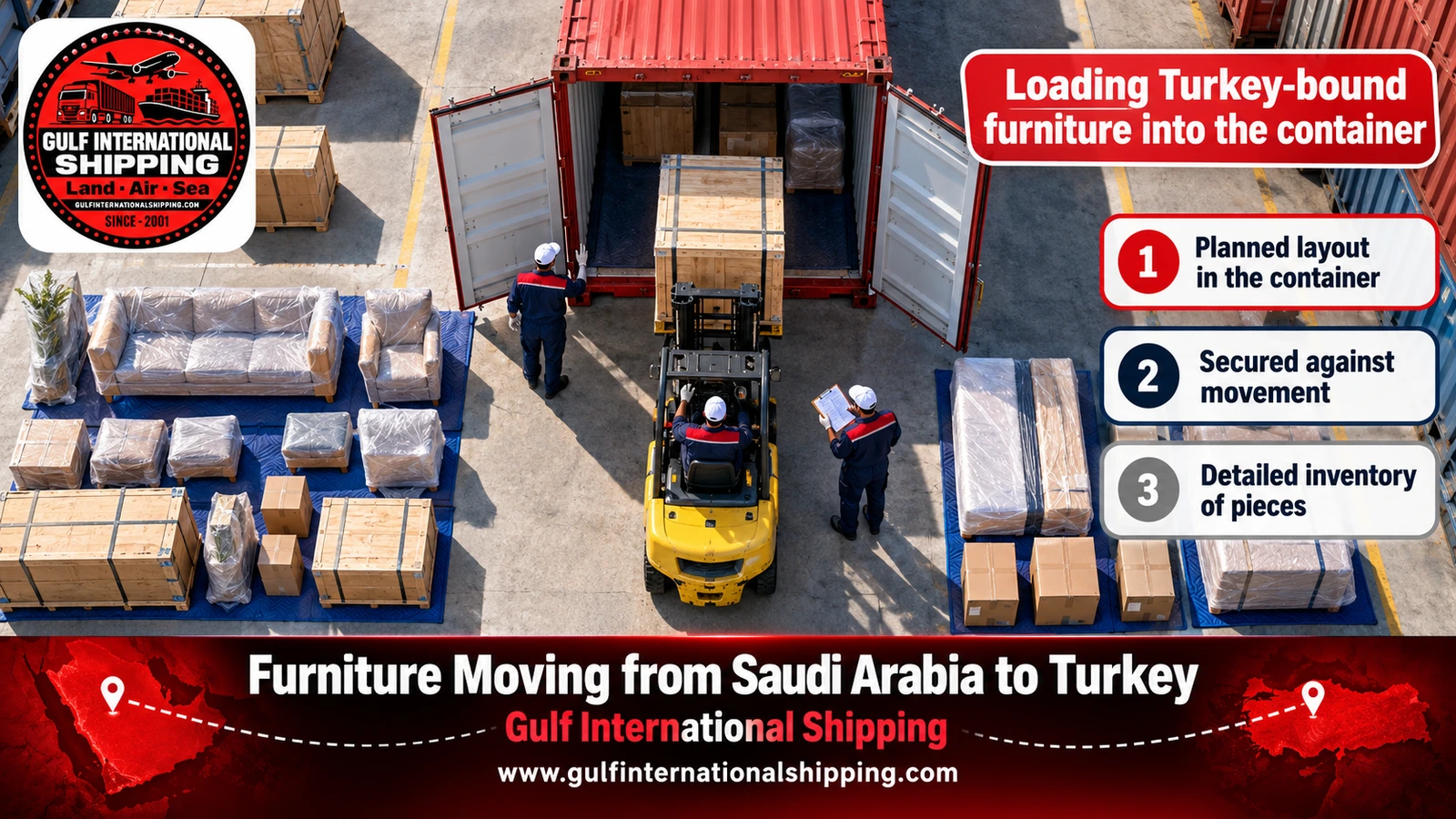
Packing furniture for the sea trip to Turkey
The voyage to Turkey is fairly short, yet the furniture stays inside the container from loading day until release at the Turkish port, which can stretch to two or three weeks, with temperature and humidity shifting between a Jeddah summer and a Marmara winter. So we pack for this particular route:
- Wood and wardrobes: bubble wrap, then a moving blanket, then tight stretch film that keeps moisture out.
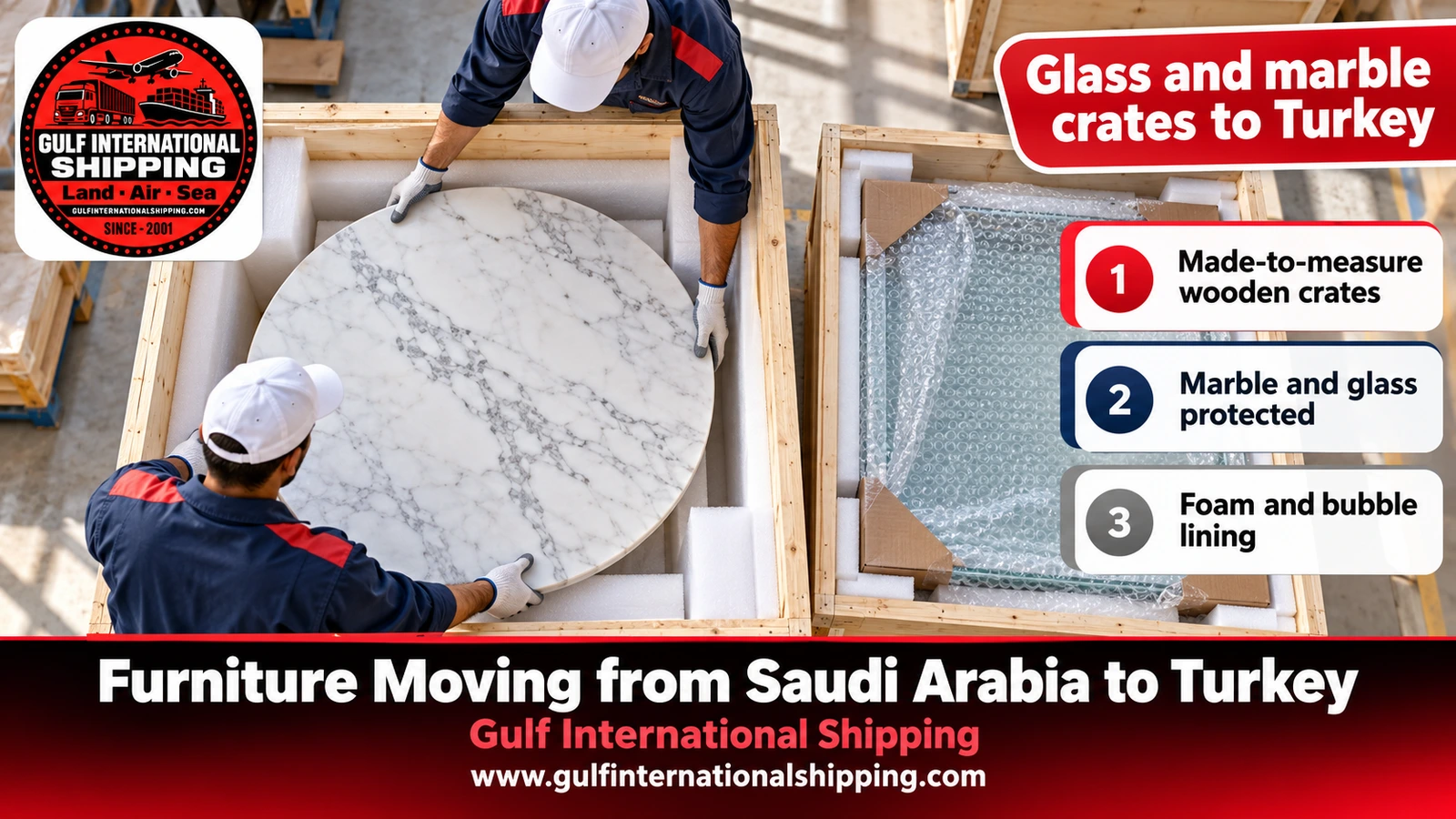
- Glass, marble and mirrors: wooden crates lined with foam and built to the size of each piece.
- Sofas and mattresses: thick sealed plastic covers, then cardboard or blankets on the corners.
- Screws and small fittings: numbered clear bags taped to the piece they belong to, so nothing goes missing at assembly.
- Appliances: water drained from the washing machine and fridge, the drum locked with transit bolts, and brand and serial number recorded.
- Inside the container: heavy items at the bottom, straps and timber bracing to stop movement, and desiccant bags on the walls.
Numbering is not cosmetic. Each carton carries a number matching a line in the inventory, and Turkish customs may ask to open one particular box. With an accurate list only that carton is opened, the inspection is over quickly, and your belongings are not spread across the port yard.
Which belongings deserve a place in the container?
Not everything in your home is worth its freight. The working rule: move what is hard to replace or costs more in Turkey, and leave what you can buy there for a similar price. A few notes from the homes we have moved:
- Electricity: Turkey runs on 230 volts at 50 hertz with round European plugs, while many appliances in Saudi Arabia are rated for 60 hertz with three-pin plugs; check each rating plate, as most work on both frequencies and only need a plug adapter.
- Huge fridges: kitchens in Istanbul flats are often smaller than in Saudi homes, so measure the space before shipping a double-door fridge.
- Air conditioners: many Turkish flats have central heating, and fitting an outdoor unit sometimes needs the building management’s approval; ship one only if you know where it will go.
- Rugs, antiques and Arabic majlis seating: hard to find in the same taste in Turkey and reasonable in volume, so usually worth moving.
- Cheap, heavy furniture: can cost more in freight than its shop value, so compare first.
- Duplicate appliances: two of the same item can be treated as commercial goods and pay duty, so keep to what suits your family size.
Documents required for moving furniture to Turkey
Paperwork depends on your status, as explained at the start of this guide, but some documents are needed from everyone for the Saudi export declaration on the Fasah platform and for issuing the bill of lading:
Spell the owner’s name on the B/L exactly as on the Turkish passport or residence permit. A single different letter can hold up the exemption and take days to correct, so we send you a draft bill of lading to check before sailing.
Phones, TVs and appliances: what to know before loading
This is the point many people miss. Turkish rules bar mobile phones from arriving by post or courier, and a foreign handset needs registration by its IMEI number, with a hefty fee, to keep working on Turkish networks after a set period. So keep your phone in your pocket on the flight and never bury it in a carton.
- Televisions: even under the exemption a “bandrol” fee is charged on TV and radio receivers.
- Appliances still in their original boxes: usually treated as new goods, so unbox and use them before shipping if they are for your home.
- Serial numbers: we record the brand and number of every appliance on the inventory, because Turkish customs checks them at inspection.
- Lithium batteries: removed from devices for air freight, and loose batteries do not fly.
Prohibited items in a furniture shipment to Turkey
The main things not accepted in household goods bound for Turkey are weapons and ammunition, narcotics, explosives and fireworks, flammable aerosols, paints, bleach and gas cylinders, currency and securities, live or dried animals and plants, aquariums with water, food and alcoholic drinks, meat products, medicines without a prescription, and drones. Gold, jewellery and gemstones have no place among the furniture either; keep them in your hand luggage. Saudi export rules separately bar weapons, antiquities and subsidised goods. If you have large amounts of perfume, cosmetics or cleaning products, tell us, because quantities are restricted.
Delivery and assembly across Turkey
We deliver furniture to every Turkish province and pick the arrival port closest to your city to shorten the road leg inside Turkey. The table shows the usual port for each area:
Assembly in Turkey has its own quirks. Many buildings in Istanbul and Bursa rely on external furniture lifts set up against the balcony, because indoor lifts are small and staircases narrow, and some old streets are closed to large trucks, so goods are switched to a smaller vehicle. We arrange this in advance once you give us the address and floor, so delivery day runs on time.

Air freight for urgent household boxes to Turkey
The furniture goes by sea, but some boxes cannot wait: clothes for the first weeks, school papers, basic kitchenware and the children’s things. These we fly, from SAR 14 per kg; they need 3 to 5 working days to reach your door in Istanbul, and 4 to 6 if home is in Ankara, İzmir, Antalya, Trabzon or Bursa.
- From Jeddah: nonstop flights to Istanbul Airport in about 3 hours 45 minutes, with many departures a week.
- From Riyadh: nonstop flights to Sabiha Gökçen Airport in Istanbul in about 4 hours.
- From Dammam: a daily nonstop to Istanbul Airport in about 4 hours 15 minutes.
- From Madinah: daily nonstop flights to Istanbul in about 3 hours 50 minutes.
- From Taif: nonstop flights according to the airline schedule, or via Jeddah airport.
- From Tabuk: via Riyadh or Jeddah, as there is no nonstop flight.

Airlines bill whichever figure is higher: what the scale shows, or what the box size equates to. So we vacuum-pack clothes and use right-sized cartons. Cosmetics are not flown as household goods; put them in the sea container instead.
Can I ship my car to Turkey with the furniture?
We ship cars to Turkey inside a closed container from Jeddah, wrapped and lashed, once they meet Turkish customs rules. A returning Turkish citizen is allowed a car aged three years or less counted by model year, held in their own name outside Turkey for half a year or more before their last entry, not used commercially, cleared within six months of arrival, and only once in any five-year period. No customs duty is charged, yet the owner still pays special consumption tax (ÖTV) and VAT, and ÖTV climbs with engine size and price to the point where it may top the value of the car itself. As for foreign residents, they are limited to temporary import while their permit stays valid. Shipping a qualifying car starts from SAR 5,060, and we handle the Saudi export through Absher and Fasah. For the complete picture, read car shipping from Saudi Arabia to Turkey.
Your move to Turkey in seven steps
- 1Tell us your status and destination
Are you a returning Turkish citizen or a foreign resident? Which Saudi city are you leaving and which Turkish city are you moving to? Send this with photos of your furniture to WhatsApp 0568829975. - 2Survey and price
We measure the cubic metres, recommend groupage or a box of your own, and you receive the cost together with the date of the next ship out of Jeddah. - 3Prepare the papers
Returnees bring the consulate certificate; residents bring the permit, tax number and notarised lease; the broker in Turkey reviews them before we load. - 4Dismantling, packing and inventory
The crew takes pieces apart, wraps them, numbers the cartons and lists brands and serial numbers. - 5Trucking to Jeddah and export
The truck delivers to the port, we file the export declaration on Fasah, and the container is loaded before cut-off. - 6Sailing and clearance
You get the container and bill of lading numbers, and we follow arrival and clearance with the broker at the Turkish port. - 7Delivery and assembly
At your address the team rebuilds beds and wardrobes, ticks every carton off the list, and you sign the delivery note.
What drives the cost of a household move to Turkey?
The price rests on five things: how many cubic metres you fill, groupage versus a box of your own, how far your city is from Jeddah port, the Turkish port of arrival and the road distance onward to your home, and extras you pick such as timber crates, storage or cover. A rough example: a Riyadh family moving a two-bedroom flat of about 18 cubic metres to Istanbul. Charged by the cubic metre on groupage it would start at 18 × 410 = SAR 7,380, whereas booking a whole 20-footer starts at SAR 4,140, so the family is better off with its own box, plus the Riyadh–Jeddah trucking and the delivery within Istanbul as quoted.
The cheapest way to move your furniture to Turkey
- Under about 10 cubic metres, shared space is cheaper; above that, ask us to compare it with a dedicated container.
- Sell or donate cheap, heavy pieces and move the valuable things and what is hard to replace.
- Land the box at the port nearest home: Mersin if you are heading to Ankara or the south, Gemlik if it is Bursa or Yalova, Ambarlı or İzmit for Istanbul and Sakarya.
- Book early, ahead of the busy moving seasons, so you catch the next sailing without storage charges.
- Have your exemption papers ready before shipping, since any gap means waiting charges at the Turkish port.
Mistakes people make when moving home to Turkey
- Shipping before the relocation certificate is issued: the container arrives and waits for the paper while storage charges mount.
- Missing the six-month window: furniture that lands more than six months after your entry can lose the exemption.
- Packing a phone or gold in the cartons: phones cannot enter by freight and jewellery is not accepted with furniture.
- A vague inventory: “household goods” is not enough; list contents, brand and number.
- A different name on the bill of lading: it must match the passport or Turkish residence permit exactly.
- An unnotarised lease or one shorter than a year: it turns permanent import into temporary import against a deposit.
Storage, insurance and tracking
Not ready to receive the furniture yet? It can wait in our warehouse in the Kingdom until you give the word, charged by time and volume. Cover for the cargo is optional and worth it for valuable pieces; the premium follows the value you declare, so ask for your quote on WhatsApp. Once the ship leaves, you get the box number and the B/L reference to follow the voyage online, and we let you know the arrival date and whatever the broker at the Turkish port needs.
Our commitments on every household move to Turkey
Your customs status first
We confirm whether you are a returnee or a resident before loading, so the port holds no surprises.
Jeddah for every shipment
Loading at the Saudi port closest to Suez, from any city in the Kingdom.
Real sea packing
Wooden crates for glass and marble, moisture protection and every piece numbered.
The right arrival port
Mersin, Gemlik or Ambarlı depending on your city, to cut the road leg in Turkey.
Assembly at your home
Beds and wardrobes rebuilt, with an external furniture lift arranged when needed.
One number throughout
Call or WhatsApp 0568829975 from the survey to delivery.
Price your move to Turkey
Share photos of the furniture plus your pickup and delivery cities, and you will have a figure and the next Jeddah departure by return.
Related articles on moving to Turkey
- shipping company from Saudi Arabia to Turkey · Turkey used household goods customs
- sea freight from Saudi Arabia to Turkey · air freight from Saudi Arabia to Turkey
- shipping prices from Saudi Arabia to Turkey · cartons and parcels shipping to Turkey
- By city: shipping from Riyadh to Turkey · shipping from Jeddah to Turkey · shipping from Dammam to Turkey · shipping from Makkah to Turkey
- furniture moving abroad · customs clearance · all destinations