


Sea freight from Saudi Arabia to Turkey starts at Jeddah Islamic Port, where containers board a once-a-week service heading north along the Red Sea coast and on via Suez, calling at Mersin after about 5 days and İskenderun after about 8; boxes for Istanbul, Bursa and İzmir reach the Marmara and Aegean ports on other services or by transshipment. Counting the whole trip from your Saudi doorstep to your Turkish one, a full container takes roughly 14–20 days to the south of Turkey and 18–28 days to Istanbul, a little more from Riyadh and the Eastern Province. Sea rates at Gulf International Shipping open at SAR 410 for each cubic metre in a shared container, SAR 4,140 when you want a twenty-foot box to yourself, SAR 6,440 for a forty-foot one, and SAR 5,060 for shipping an eligible car.
The sea is the natural route for anything big or heavy bound for Turkey: whole households, cars, traders’ stock, and family cartons that are in no hurry. This page is a guide to the voyage itself: which quay the container leaves from, how many days it spends at sea to each Turkish port, which port suits your destination, how cubic metres are measured, the point at which a private container becomes cheaper, and the paperwork at departure and arrival. For the general overview of services and prices, start with shipping company from Saudi Arabia to Turkey.
Key numbers
- Loading quay: Jeddah Islamic Port for every Turkey container; distant cities reach it by truck
- Days at sea: Jeddah → Mersin about 5, Jeddah → İskenderun about 8; Marmara and Aegean take longer
- Door to door: from the Hijaz: two weeks to 20 days for Mersin and Adana, about 3–4 weeks for Istanbul, close to a month for Trabzon
- Shared container: SAR 410 or more per cubic metre, and 5–7 days slower than a full one
- Private container: twenty-footers from SAR 4,140; forty-footers from SAR 6,440
- Cars: inside a closed container only, from SAR 5,060 for an eligible car
- Turkish clearance: roughly a working week, 4–5 days, for second-hand household effects with a full file
Jeddah → Red Sea → Suez → eastern Mediterranean → Mersin or Marmara · 0568829975
Sailing times from Jeddah to Turkish ports
Every Turkish port has its own sea time, and its door-to-door time differs again depending on the road leg after discharge. The table brings together what you need to know about each port we use:
The gap between the “days at sea” column and the “to the door” column is what many people overlook. The ship does not wait for you: before sailing, the container has to be packed, trucked to Jeddah, covered by an export declaration and gated into the terminal before the cut-off, which usually takes 3–5 days. After arrival comes Turkish clearance and then the inland road. That is how five days at sea to Mersin become two weeks to twenty days door to door, and why any company promising your furniture in Istanbul by sea within a week is leaving those links out.
The weekly line between Jeddah and southern Turkey
Jeddah is linked to southern Turkey by a weekly Turkish liner service known as the Türkiye Red Sea Service, which calls at Jeddah and Aqaba and continues to Mersin and then İskenderun. Because it sails once a week, your loading day matters a great deal: deliver the box a day before cut-off and it catches the next vessel; deliver it a day late and it waits a full week. So when you book we give you the cut-off date and the expected sailing date and schedule the packing around them.
The Marmara and Aegean ports, Ambarlı, Gemlik, İzmit and İzmir, are reached from Jeddah on other lines or by moving the container onto a second ship at a hub port. For those we give a door-to-door range rather than a fixed number of sea days, and confirm the actual figure against the vessel schedule at booking. Either way, we check navigation conditions on the Red Sea and at Suez before confirming.
Why doesn’t every container go straight to Istanbul?
Because the shortest and most regular line from Jeddah ends in southern Turkey. If your city is Ankara, Konya or Adana, it is usually quicker to discharge at Mersin and continue by truck than to sail on round to the Sea of Marmara.
From your city to the Jeddah quay: the road leg before sailing
Jeddah Islamic Port is where every Turkey container starts with us, whatever your city. The reason is pure geography: Jeddah sits on the Red Sea, which leads directly to Suez and the Mediterranean, whereas a ship leaving an Arabian Gulf port must first sail all the way round the Arabian Peninsula. So we do not book Turkey containers from Dammam port; our closed truck brings Eastern Province loads to Jeddah, as it does from Riyadh, Qassim and Tabuk.
For the road leg, a full container can be stuffed outside your home and then hauled to Jeddah on a truck as it is, or your goods can travel in a closed truck to our Jeddah warehouse and be stuffed there. The first option suits villas with space in front; the second suits flats in busy neighbourhoods. For shared shipments, your goods are consolidated at the warehouse with other cargo before going into the container.
Mersin: the nearest gateway to southern and central Turkey
Mersin is the largest port on Turkey’s south coast and the closest to Jeddah, and it is the first discharge port for the weekly line. From there we deliver to Mersin itself, Adana, Gaziantep and Konya, to Ankara about 500 km away by road, and to Antalya and Alanya roughly 480 km along the coast. Many customers heading for the Turkish capital are surprised to learn that their route through Mersin is shorter than one through Istanbul.
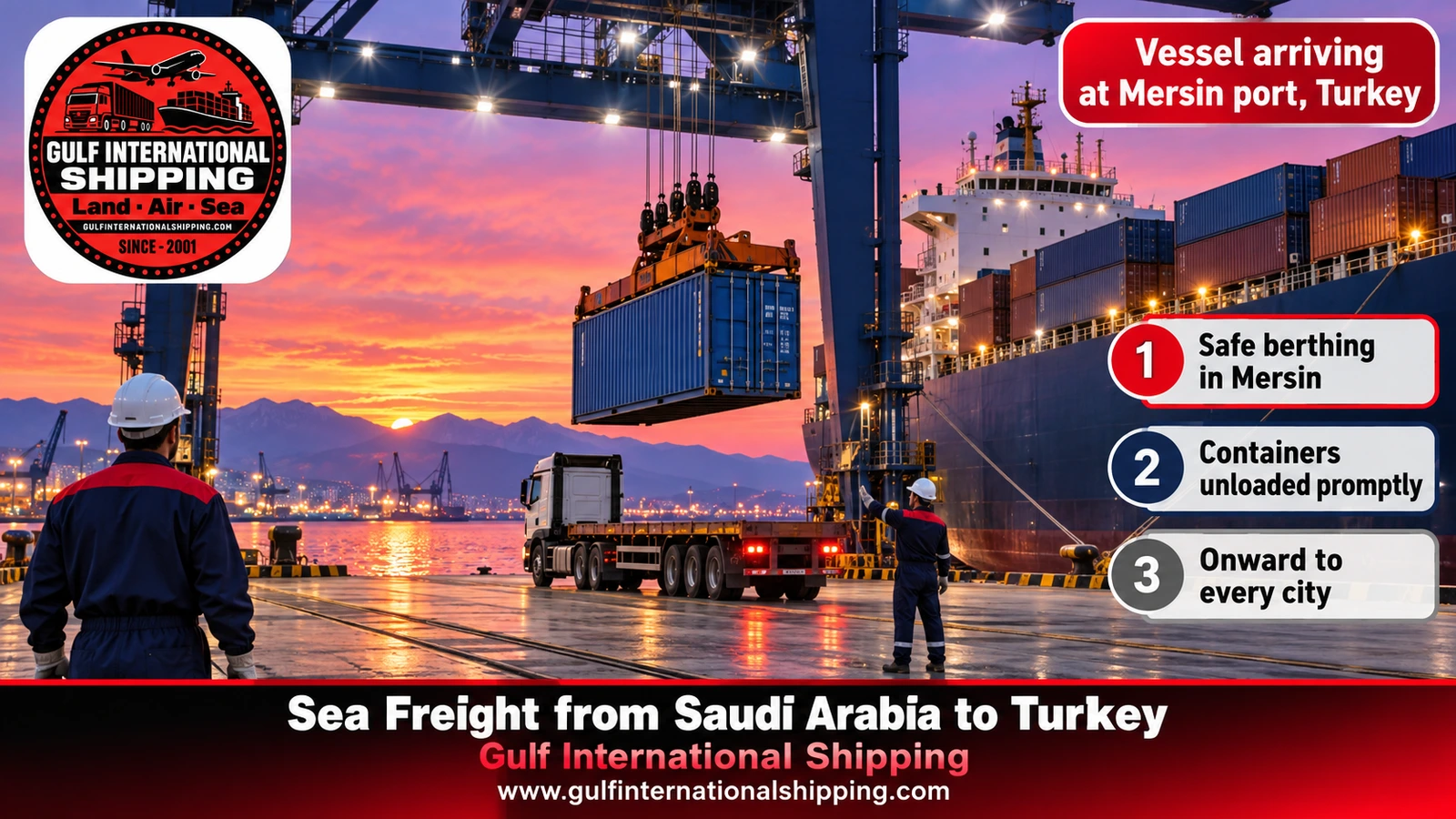
After discharge the container moves to the customs yard, the broker files the papers, and an inspection is scheduled. For used household goods this normally takes 4–5 working days; then the container leaves on a truck for the address, or, if it is a shared box, is unloaded at a warehouse so each consignment can be sorted for its owner.
Ambarlı, Gemlik and İzmit: the Marmara ports for Istanbul and Bursa
Ambarlı, on Istanbul’s European side, is the biggest container port in the Marmara region, and from there consignments spread to both shores of the city and on to Tekirdağ and Sakarya. Gemlik, on the southern shore of the Sea of Marmara, is the closest port to Bursa and Yalova and also serves İzmit and Eskişehir. İzmit and Derince in Kocaeli province are a good alternative for anyone living in Sapanca, Adapazarı or eastern Istanbul.
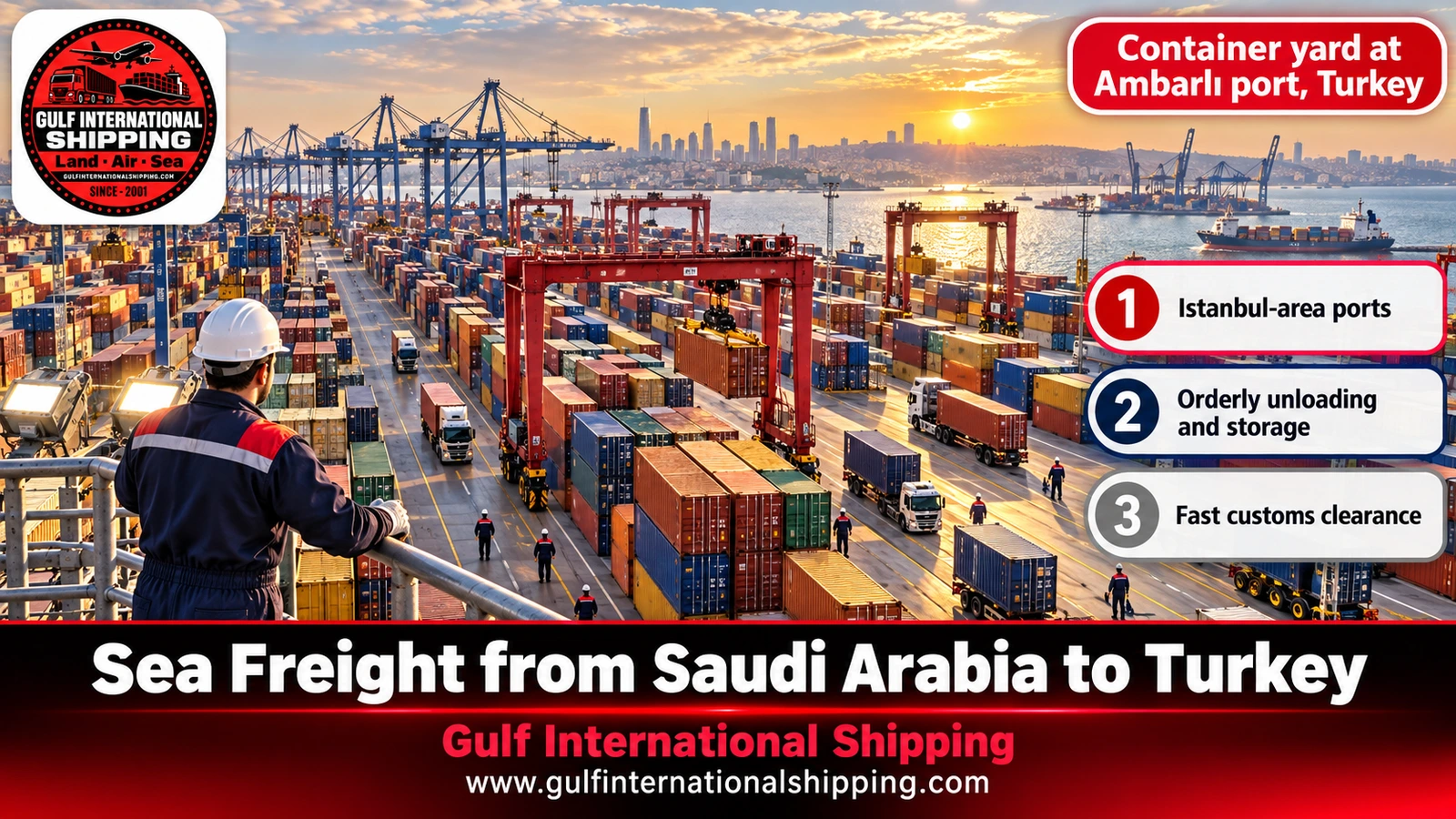
The right Marmara port spares you Istanbul’s traffic and can cut the inland leg by a day or more. If your home is in Bursa, there is no sense in discharging at Ambarlı and then crossing the bridge and motorways south. We choose the best port with you at booking, based on the available line and your address.
İzmir, Antalya and Trabzon: the further destinations
İzmir on the Aegean has its own port, with Aliağa to the north, and together they serve İzmir, Manisa and Denizli. Antalya is not on a direct line from Jeddah, so its containers are best discharged at Mersin and trucked along the coast road. Trabzon, Uzungöl and Rize on the Black Sea are reached by truck from the Marmara ports, a road trip of about 1,050 km, which makes them our longest destinations at roughly 21–30 days from the Hijaz.
Shared container (LCL): how a cubic metre is measured and priced
Shared freight means paying for the slice of a container you occupy, never for the whole box. That space is worked out by multiplying length by width by height in metres. Take a carton of 60 × 40 × 40 cm: its volume is 0.096 m³, so ten of them stacked together come close to a single cubic metre. A complete bedroom, dismantled and packed, usually takes up a few cubic metres depending on the size of the wardrobe and bed.
Shared space with us starts at SAR 410 per cubic metre. The container is consolidated at our Jeddah warehouse until it is full, then sails, and is unloaded and sorted at a Turkish warehouse, which is why it takes 5–7 days longer than a full container. It suits students, small families, anyone sending a room or two, and anyone not in a hurry.
Private container (FCL): which size do you need?
A full container is booked for you alone; it is stuffed and sealed, and nobody but our crew handles your goods until the Turkish inspection. Inside, a twenty-footer offers about 33 m³, normally enough for a flat with two or three bedrooms. A forty-footer holds close to twice that and is chosen by villa owners and by people whose furniture travels with a car.
As a working rule, under about ten cubic metres the shared option wins on price; beyond that the gap closes until a private container is both cheaper and faster. We work out the volume with you from photos or a survey before recommending either.
Sea freight prices from Saudi Arabia to Turkey
Each entry figure here sits below the cheapest rate we found published by competitors for the same item. Duty and VAT charged by Turkish customs on new items, trade goods and cars are not included:
Note: around five sailing days separate Jeddah from Mersin; counted from home to home a private container needs about 14–34 days according to the two cities, and shared freight adds 5–7.
Entry prices by loading city
Because every container sails from Jeddah, some items are priced differently depending on the road distance to the port. These are the entry figures for three items in each city:
For every city’s full list, open shipping prices from Saudi Arabia to Turkey; meanwhile shipping from Riyadh to Turkey explains the truck run from the capital, shipping from Jeddah to Turkey covers loading right at the port, and shipping from Dammam to Turkey describes the long haul from the east.
Sea packing: what your furniture needs for weeks in a container
A sealed steel container passes through the heat of the Red Sea, then cool nights and the humid Mediterranean, and condensation can form on its inner walls. So we wrap wooden furniture in bubble film, add board on the edges and finish with a tight plastic skin, place moisture-absorbing bags in the container, and keep mattresses and sofas in sealed covers. Mirrors, glassware and heirlooms travel in made-to-measure timber crates.
When loading, heavy items go at the bottom and light ones on top, weight is spread across the container floor, and everything is strapped and the gaps braced with timber so nothing moves as the ship rolls. Every carton carries a number matching the inventory, and every electrical appliance has its make and serial plate photographed, which is what Turkish customs need if they ask for an inspection.
A car in a container: our only method for Turkey
Every car we send to Turkey goes in a closed container, wrapped and with the wheels chocked and strapped; we do not use roll-on/roll-off vessels or aircraft. Nor do we accept a car before confirming it can enter: Turks moving back may import a vehicle of model year no more than three years old, owned by them where they lived for at least six months prior to their most recent arrival, and pays ÖTV and VAT even when exempt from customs duty; foreigners holding residence get temporary admission that ends with the permit. Car shipping starts at SAR 5,060, and the car can travel with the furniture in a forty-foot container. Worked examples: car shipping from Saudi Arabia to Turkey.
Commercial goods by sea: containers for traders, reefers for food
A trader exporting to Turkey regularly gains most from a full container, which is loaded at the warehouse, sealed and arrives as it left. Smaller lots travel in shared containers from SAR 1,100 for 50–300 kg. Trade cargo travels with a certificate of origin, a commercial invoice and a weight-by-package list, as well as the Turkish importer’s tax number, and it pays customs duty according to its tariff heading followed by 20% VAT. Dates and foodstuffs need specific approvals and, depending on the product, a refrigerated container. Exporters: goods shipping from Saudi Arabia to Turkey covers tariffs and reefer boxes.
Sea freight paperwork: from Fasah to the bill of lading
Before departure we lodge the export declaration on Fasah once you have authorised us electronically, attaching the inventory and your Saudi identity document. The ocean bill of lading is then issued; it proves your ownership of the container and is what the goods are released against in Turkey. Put your name on it exactly as it is in your passport, because a single different letter holds up clearance.
At the Turkish end the broker asks for papers that depend on your situation: a returning Turk provides the relocation certificate, a settled foreigner shows the ikamet card, tax office number and a notary-stamped tenancy, and a commercial shipment needs the invoice and the importer’s tax number, plus a notarised mandate for the broker. The cases are explained in detail in Turkey used household goods customs.
Clearance at the Turkish port and storage days
Once the ship arrives, the container stays in the port yard until it is released, and releasing used household goods with a complete file and the owner present usually takes four to five working days. Containers get a limited number of free days at the port, after which storage is charged for every extra day. So the most useful money-saving step is to have your Turkish papers ready before the ship sails, not after it arrives.
Marine insurance for the shipment
Marine insurance is optional and, depending on the policy, covers damage in transit and handling. It is priced as a small share of what you declare the goods to be worth, so we ask for an approximate value for your furniture or goods and send the insurance price along with the freight. We particularly recommend it for expensive appliances, antiques and cars.
When should you choose air instead of sea?
The plane is the alternative when time matters more than cost. Air cargo needs 3–5 working days to Istanbul counting pick-up and drop-off, and Ankara, İzmir, Antalya or Trabzon 4–6, at SAR 14 a kilo or more. Parcels travel on scheduled flights to Istanbul from Jeddah, Riyadh, Dammam and Madinah; from Taif, either on the direct flights in the airline timetable or through nearby Jeddah, and Tabuk routes via Riyadh or Jeddah.
Aircraft come with their own limits: lithium batteries are separated from devices or sent under special conditions, and perfume or cosmetics in quantity are refused; air freight from Saudi Arabia to Turkey lists every airport.
How to shorten sea transit and lower its cost
- Book a few days before cut-off: missing the weekly vessel means an extra week.
- Choose the port nearest your city: southern and central addresses via Mersin; Bursa and Yalova via Gemlik.
- Prepare the Turkish papers early: clearance delays mean storage charges.
- Reduce the volume: do not ship cheap items that cost more to move than to replace in Turkey.
- Compare shared and private: above about ten cubic metres a private box becomes better value.
- Avoid peak season: container demand rises before summer and the holidays.
Find out when the next ship leaves for Turkey
Share photos or a rough volume plus both cities; we answer with the right port, the cut-off, the sailing and the price.
Further reading for sea shippers
- All our Turkey services at a glance: shipping company from Saudi Arabia to Turkey. Moving house? furniture moving from Saudi Arabia to Turkey
- Paperwork and exemptions before sailing: Turkey used household goods customs; for cars: car shipping from Saudi Arabia to Turkey
- For traders goods shipping from Saudi Arabia to Turkey, for small and light loads cartons and parcels shipping to Turkey, and when it is urgent air freight from Saudi Arabia to Turkey
- From the holy cities and Taif: shipping from Makkah to Turkey; Madinah and Yanbu: shipping from Madinah to Turkey; the summer resort: shipping from Taif to Turkey; the north: shipping from Tabuk to Turkey
- Our general services: customs clearance under your mandate, car shipping in containers, furniture moving abroad to every country, and the list of other shipping destinations