
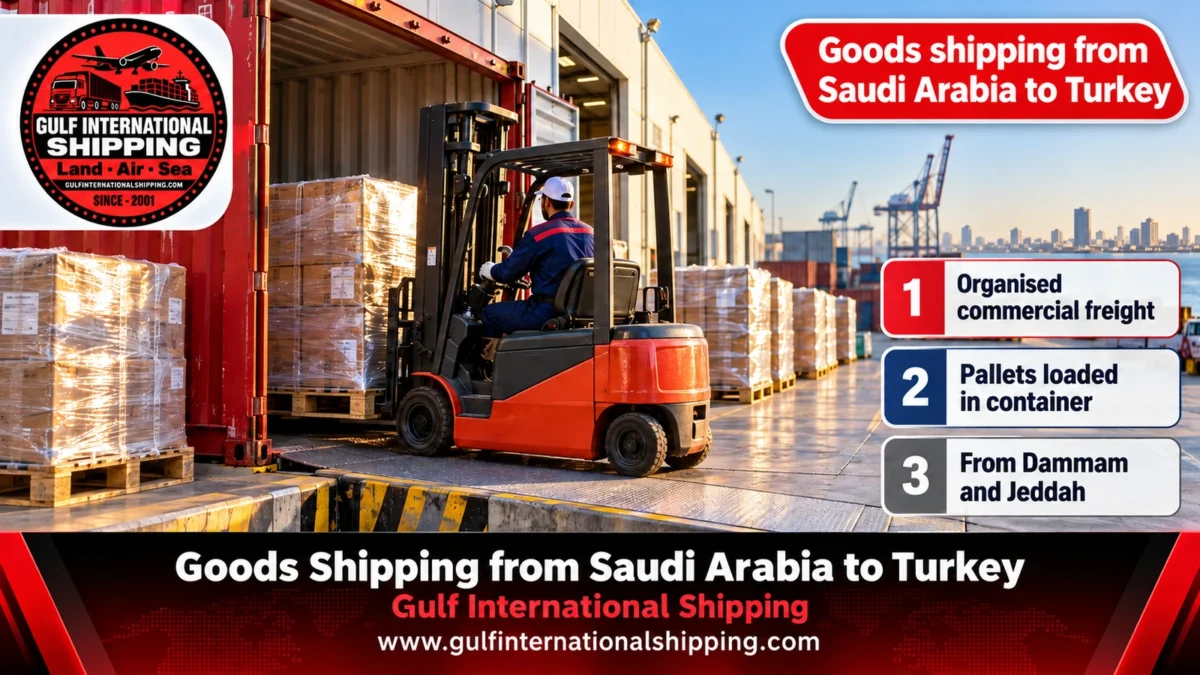
Gulf International Shipping carries commercial goods from any Saudi city to Turkey by sea and air: we collect the cargo from your warehouse, file the export on the Fasah platform and it leaves Jeddah Islamic Port in a groupage box or a container of your own, berthing at Mersin after roughly five days afloat or carrying on to the terminals for Istanbul, Kocaeli and Bursa, where it is cleared in the Turkish importer’s name and delivered to their warehouse. An order out of Jeddah needs 14–20 days to a warehouse in Mersin or Adana and 18–28 days to one in Istanbul, Kocaeli or Bursa; orders from Riyadh take two or three days more and from Dammam three or four, while flown samples reach Istanbul in 3–5 working days. On the Gulf International Shipping rate card a groupage cubic metre starts at SAR 410, a 50–300 kg consignment at SAR 1,100, a container of your own at SAR 4,140 (20-footer) or SAR 6,440 (40-footer), and air at SAR 14 a kilo.
Our audience here is the trader, the factory and the online seller selling to a buyer in Turkey or supply a branch of their own company there. Rather than telling you that shipping matters, it answers the questions that actually decide your margin: who is the registered importer in Turkey, which missing paper will Turkish customs refuse to work without, when does a full container beat paying by the cubic metre, and how much VAT will your buyer pay at release?
In short
- Loading port: Jeddah Islamic Port for every shipment; cargo from Riyadh and the Eastern Province is trucked to Jeddah first
- Turkish ports: Mersin (about 5 days at sea) and İskenderun (about 8 days), plus Ambarlı, İzmit, Gemlik and İzmir on other services or by transshipment
- Lead time: Jeddah → Mersin 14–20 days · Jeddah → Istanbul or Kocaeli 18–28 days · air to Istanbul 3–5 working days
- Costs: groupage SAR 410+ a cubic metre · 50–300 kg consignment SAR 1,100+ · 20-footer SAR 4,140+ · 40-footer SAR 6,440+
- Taxes in Turkey: customs duty by tariff line, then 20% VAT paid by the importer
- Core documents: commercial invoice, packing list, certificate of origin, bill of lading and the importer’s Turkish tax number
Route: exporter’s warehouse → Fasah → Jeddah quay → Suez → Mersin, İzmit or Ambarlı → importer’s warehouse · Contact: 0568829975
Who is the importer in Turkey? The first question for any commercial shipment
A commercial shipment is not released in Turkey to “somebody”. It is released to a registered importer with a Turkish tax number (Vergi Numarası) who works through a licensed customs broker (Gümrük Müşaviri). The importer might be the customer who bought the goods, your company’s Turkish branch or a trading agent. What matters is that their name, address and tax number appear identically on the commercial invoice and the bill of lading, because any mismatch between the two stops clearance until it is corrected.
If you are selling to a Turkish buyer for the first time, ask them for three things before shipping: their tax number, the name of their customs broker, and confirmation that the goods need no special permit before import. Some categories, such as food, cosmetics, electrical appliances and toys, go through conformity and standards checks in Turkey before release, and it is the importer who applies for these. We coordinate with their broker from the moment of booking so the container never arrives before its paperwork is ready.
If you have no importer in Turkey
If you are sending goods to yourself to sell in Turkey and have no company there, you will need an arrangement with a registered importer or a local business entity. Tell us your plan before shipping and we will set out the practical options with the Turkish broker.
Delivery terms between seller and buyer: who pays for what?
The delivery term you agree with your Turkish buyer decides who pays for freight and who carries the risk at each stage. These are the terms used most often on Saudi–Turkey shipments, and what each means in practice with Gulf International Shipping:
DDP, where the seller also pays Turkish duty and VAT, needs a special arrangement with a registered importer in Turkey, so we discuss it case by case rather than offering it off the shelf. Under every term we handle the Saudi leg and the voyage and work with the buyer’s broker at the Turkish port.
Documents required for shipping goods to Turkey
One missing document means days of port storage charges in Turkey. This is the list we go through with every commercial customer before loading:
Give each line on the invoice a clear trade description, not “assorted goods”, and add the Harmonised System (HS) code if you know it. Turkish customs classifies every item under a detailed tariff line and charges duty accordingly, and a vague description invites a full inspection of the container.
Approximate cost of shipping goods from Saudi Arabia to Turkey
Gulf International Shipping starting prices sit 5–10% below published commercial rates to Turkey. They cover freight to the agreed destination and exclude Turkish customs duty and the VAT paid by the importer.
Note: a sea order from your warehouse to the importer’s takes 14–20 days when it sails from Jeddah for Mersin, or 18–28 days when the importer is in Istanbul or Kocaeli; factories in Riyadh, Qassim and Tabuk add two or three days, the Eastern Province three or four, and groupage around a week, while air reaches Istanbul in 3–5 working days.
Prices for common commercial items
LCL or FCL for commercial goods?
On shared space (LCL) your goods share a container with other exporters’ cargo and you pay by volume in cubic metres or by weight, whichever is higher under ocean-freight rules. Book a full container (FCL) and nobody else’s cargo shares it: we stuff it at your warehouse, fit the seal, and it stays shut until the Turkish port. Price is not the only difference:
Expect roughly 33 m³ and about ten standard pallets on the floor of a 20-footer, and roughly 67 m³ and 20 to 21 pallets in a 40-footer. If your cargo is heavy but compact, such as tiles or metal, a 20-footer is often the better fit because it reaches its weight limit before it fills up. We price both options for you before booking.
The cargo’s journey: from your warehouse to Mersin and the Marmara ports
All our containers to Turkey sail from Jeddah Islamic Port, which faces the Suez Canal directly across the Red Sea. If your warehouse is in Riyadh the truck covers about 950 km to Jeddah, from Dammam and Jubail about 1,400 km, and from Qassim and Tabuk distances similar to Riyadh’s. It is our routing choice for all commercial cargo, and it gives a fixed weekly sailing from Jeddah.
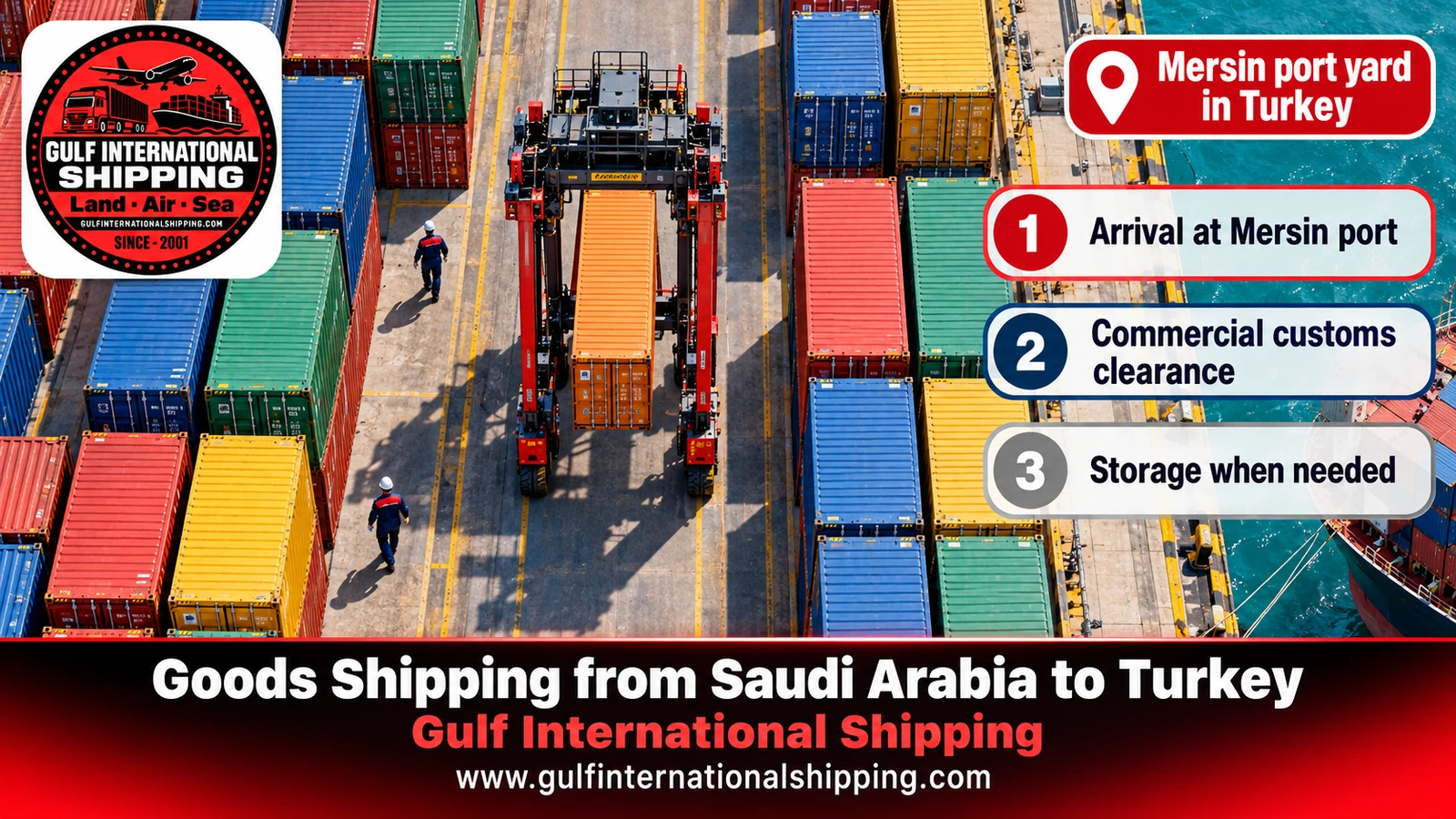
On the weekly direct line a box spends roughly five days at sea to Mersin and about eight to İskenderun. Mersin is the natural gateway for cargo bound for Adana, Gaziantep, Konya and Ankara, which lies about 500 km away by road. Importers in Istanbul, Kocaeli and Sakarya usually receive through Ambarlı or İzmit, those in Bursa through Gemlik, and İzmir and Manisa through İzmir or Aliağa, on other services or by transshipment, so transit there is several days longer. Before locking in any booking we look at the current navigation picture in the Red Sea.
Customs duty and VAT in Turkey
At release the Turkish importer pays two main amounts. First, customs duty, set by each item’s tariff line and origin, sometimes with additional duties on certain lines. Second, VAT at the standard rate of 20%, with reduced rates for some goods, worked out on the goods’ value with freight and duty added. We do not publish one duty rate for all goods because it varies widely between products; ask the importer’s broker to cost your invoice lines before you ship.
A special word for e-commerce: online-store parcels to Turkey no longer go through a simplified procedure and now follow the normal import regime with duty and VAT. So if you sell to private customers in Turkey, it is usually cheaper to ship stock by sea to a partner warehouse there and distribute locally, rather than send a separate parcel to every buyer.
Goods that need special handling
Dates and foodstuffs
Saudi dates are among the products we are asked about most. Commercial food needs an import approval from the Turkish Ministry of Agriculture, obtained by the importer before shipping, and a health or export certificate from the relevant Saudi authority may be required. We ship in dry or refrigerated containers depending on the product and equipment available on the service, with foodstuffs from SAR 23 per kg. Food is not recommended in personal parcels.
Perfume and cosmetics
These travel by sea in sealed cartons with an ingredients list and are checked in Turkey before release. Flammable products cannot fly in commercial quantities unless classified and packed as dangerous goods, so tell us the composition before booking.
Electrical and electronic goods
The invoice needs clear models and serial numbers, and conformity checks may apply. Mobile phones cannot be sent to Turkey by post or courier, so commercial phone shipments need a registered importer and the device registration process.
Industrial equipment and spare parts
These are secured on timber pallets or in crates and charged by weight or volume. Industrial equipment starts from SAR 920 and car spare parts from SAR 460; very large machinery can be studied for open-top containers when needed.
Air freight for samples and urgent orders to Turkey
When your buyer is waiting for a sample before confirming a large order, or a shop has run out of stock, air is the answer. Air freight starts from SAR 14 per kg and express parcels of 10–50 kg from SAR 550, so a sample is in Istanbul after 3–5 working days and in Ankara, İzmir or Bursa after 4–6. Cargo leaves Jeddah on nonstop flights to Istanbul Airport of about 3 hours 45 minutes, Riyadh on nonstops to Sabiha Gökçen of about 4 hours, Dammam on a daily nonstop and Madinah on daily nonstops; Taif has nonstop flights according to the airline schedule or connects via Jeddah, and Tabuk connects via Riyadh or Jeddah. Airlines bill on whichever is larger, the weighed kilos or the size-equivalent kilos, and lithium batteries are removed or shipped under dangerous-goods rules.
Delivery to Turkish industrial zones
We deliver to importers’ warehouses across Turkey, most of them in the organised industrial zones (OSB) around Istanbul, Kocaeli and Bursa, and in Mersin, Adana, Gaziantep and Konya in the south and centre. We choose the arrival port according to the warehouse location and send the importer the estimated arrival date in advance, so the unloading bay and crew are ready.

Steps for shipping goods from Saudi Arabia to Turkey
- 1Brief us on the cargo
Type of goods, quantity, weights and dimensions, pickup city and the importer’s city in Turkey, to WhatsApp 0568829975. - 2Choose the mode and price
We suggest shared space, a full container or air, and send the quote, sailing date and a suitable delivery term. - 3Check documents with the importer
Invoice, packing list, certificate of origin, Turkish tax number and any prior approval the item needs. - 4Loading and export
We collect from your warehouse or load the container on site, file the export declaration on Fasah and truck it to Jeddah port. - 5Sailing and tracking
We send the bill of lading and container number to the importer and their broker and advise the arrival date. - 6Clearance and delivery
The importer clears the goods and pays duty and VAT, and we deliver to their warehouse by a suitable truck.
Mistakes that hold up goods in Turkish ports
- A different importer name on the invoice and the bill of lading, or a missing tax number.
- Generic descriptions such as “assorted goods”, which trigger a full container inspection.
- Shipping an item that needs approval before the importer has obtained it, so the box waits in port.
- An unrealistic invoice value, which customs will reassess.
- Weak pallet wrapping on shared space, leading to damage when the box is unpacked.
- Skipping marine insurance on high-value cargo.
Importing from Turkey to Saudi Arabia
Many of our trade customers export to Turkey and import from it too: furniture, textiles, building materials and food. The same sea service runs in the other direction, a Mersin–Jeddah crossing taking roughly eight days, after which we truck the goods to Riyadh, Dammam or any other city. Ask about imports alongside your next shipment, as running both directions can lower your overall cost.
Do you ship cars to Turkey?
We ship cars to Turkey inside a closed container from Jeddah once they meet Turkish customs rules: a returning Turkish citizen may bring a car of three model years or less registered to them for at least six months, paying ÖTV and VAT, and a foreign resident may bring one in only temporarily while the permit runs. Other used-car imports need permits that are rarely granted. Shipping starts from SAR 5,060; see car shipping from Saudi Arabia to Turkey for details.
Why Gulf International Shipping for your goods to Turkey?
We start with the importer
Tax number and the buyer’s broker confirmed before booking.
Weekly sailings from Jeddah
A direct service to Mersin in about 5 days, and the Marmara ports on other services.
LCL and FCL in figures
Both options priced for your volume and weight before you pay.
Complete export papers
Fasah declaration, invoice, packing list and certificate of origin.
Delivered to the warehouse
From the port to industrial zones across Turkey.
A single contact
Your trade desk on call or WhatsApp at 0568829975.
Get a freight figure for your Turkish order
Tell us the product, the volume and where the importer is, and the rate plus the next Jeddah departure will come straight back.
Related articles on shipping to Turkey
- shipping company from Saudi Arabia to Turkey · sea freight from Saudi Arabia to Turkey
- air freight from Saudi Arabia to Turkey · shipping prices from Saudi Arabia to Turkey
- cartons and parcels shipping to Turkey · car shipping from Saudi Arabia to Turkey
- By city: shipping from Riyadh to Turkey · shipping from Jeddah to Turkey · shipping from Dammam to Turkey
- customs clearance · air freight · all destinations