


Car shipping from Saudi Arabia to Oman is handled by Gulf International Shipping overland from every major Saudi city, on your choice of a shared carrier, a dedicated flatbed or an enclosed transporter, through the Empty Quarter border port to Muscat, Sohar, Nizwa and Salalah. Before price and timing, though, two conditions decide everything: Oman accepts a private car only if it is less than 7 years old, and it requires an export certificate from the country where the car is registered. Once both are met, transport opens at SAR 1,840 out of the Eastern Province; a sedan riding a shared deck out of Riyadh or the west starts at SAR 2,020, and a prestige car boxed in an enclosed unit at SAR 4,140. Muscat is three to five working days away from the capital or the Gulf coast.
This guide is built around the questions that actually land in our WhatsApp: “My car is an older model — will it get in?”, “Which paper do the Omani police want?”, “How much duty will I pay?”, “Should I drive it myself or ship it?”. So we start with Oman’s conditions, then the Saudi paperwork, then the full cost from transport to tax, and finally what happens once the car reaches your home in Muscat.
Quick facts
- Age limit: Oman admits private cars that are under 7 years old, according to Omani customs conditions
- Key document: a Saudi export certificate, issued once the vehicle export is completed on Absher; the Royal Oman Police require it for cars coming from the GCC
- Transport: SAR 1,840 upwards from the Eastern Province; SAR 2,020 on a shared carrier from Riyadh and the west; SAR 2,760 when an SUV rides a hydraulic flatbed; SAR 4,140 upwards for prestige cars
- Charges in Oman: a 5% customs duty, followed by 5% VAT whose base includes that duty
- Transit: Riyadh or the Eastern Province to Muscat in 3–5 working days; the Hejaz cities 5–7 days; Tabuk, the furthest, about 6–8 days
- Route: by road through the Empty Quarter port and Ibri; we do not fly cars
Car shipment: Absher → Fasah → Empty Quarter port → Bayan → Omani registration · 0568829975
Will Oman accept your car? Import conditions to check first
The first thing we ask every customer is not “where is the car?” but “what year was it made?”. Omani customs conditions for importing used vehicles require a private car to be under 7 years old. Other categories have their own ceilings: used trucks and buses under 10 years, equipment under 15. Very old cars follow a separate path: at 30 years a permit from the Directorate General of Traffic is needed, and beyond 50 years the car falls into the classic category.
The car must also meet Omani standard specifications, be left-hand drive and normally be built to GCC specs. A car that has previously been flooded, burned or written off after a major accident is generally refused registration, so we advise against shipping one with that history until its owner has confirmed it will be accepted. The importer must be at least 18.
A common myth: “cars up to 10 years old are fine”
Some shipping pages say cars up to 10 years old can enter Oman. That figure applies to trucks and buses, not private cars. For private cars the bar is set below 7 years, and anyone who ships an 8- or 9-year-old car on the strength of that claim risks having it turned back at the border and paying to bring it home.
Why does this matter before you book? Because a car refused at the border does not simply vanish: it comes back at your expense, or sits in the customs yard until the problem is solved. Age is generally reckoned from the year of manufacture on the registration, so if yours is close to the limit, send us a photo of the istimara before taking any other step and we will check it with you.
The Saudi export certificate: the paper the Omani police ask for
For vehicles arriving from other Gulf states, the Royal Oman Police want to see an export certificate from the authority that registered the car, and no longer accept the GCC clearance certificate on its own. The rule applies at land, sea and air entry points. In practice, for a Saudi-registered car, it means the vehicle must be formally exported through the Saudi traffic system before it heads for the border.
Most pages about shipping cars to Oman leave this out, and it is a frequent reason cars get held at the crossing. That is why the export certificate sits at the top of our preparation list, and we do not load a car until we have seen the export completed.
- 1Clear any fines
Unpaid traffic violations block the export service, so check Absher before anything else. - 2Check registration and inspection
A valid istimara and a valid periodic inspection are normally needed for the export to go through. - 3Release any finance lien
A financed car needs a release letter or the bank’s consent before it can be exported. - 4Complete the vehicle export on Absher
Export plates are issued along with the certificate the Omani authorities rely on. - 5Hand us the papers
Our team lodges the Fasah export entry and reserves a timed slot for the carrier at the Empty Quarter port.
If the car is not in your name, the paperwork needs an authorisation from the owner. If you are outside the Kingdom, most steps can be completed by someone acting for you under an authorisation, and we work with them until the documents reach us complete.
Approximate prices for shipping cars from Saudi Arabia to Oman
What Gulf International Shipping charges to move a car depends on three things: the pickup city, the type of carrier and the size of the vehicle. Our starting rates sit below the lowest figures other carriers publish on this lane, and where a city has no published price of its own we took the nearest city that does. Each row gives two numbers: our starting point, then the level the price usually reaches for bigger vehicles or far-off Omani destinations.
Note: expect a car loaded in Riyadh or Dammam to be in Muscat within 3–5 working days, while Hejaz cars need 5–7 days and a Tabuk car about 6–8; Salalah adds further days, and everything shifts with border congestion and the speed of Bayan clearance.
Starting rate by pickup city
You may be surprised that the starting rate from Jeddah or Tabuk matches Riyadh’s. That is because no published car prices exist for the western cities, so we used Riyadh’s, since the road from the west runs through it anyway. The longer trip does feed into the final figure depending on the season and how full the carrier is, so we confirm the exact amount before loading. Delivery to Salalah or Duqm costs more than Muscat because of the distance, and we price it by address. To compare every type of shipment, see shipping prices from Saudi Arabia to Oman.
Shared carrier, dedicated flatbed or enclosed transporter?
The shared carrier takes cars belonging to several customers on its two decks in a single run, which is why it is the cheapest option. It suits everyday and family cars, but its departure depends on filling the deck, and the car rides uncovered through sun and sand from start to finish.
The dedicated flatbed carries your car alone, so departure is your call and nothing is loaded above or beside it. A hydraulic flatbed lowers its platform to the ground, so low or heavy cars roll on without scraping the front bumper. We use it for large SUVs and modified cars that cannot handle a steep ramp angle.
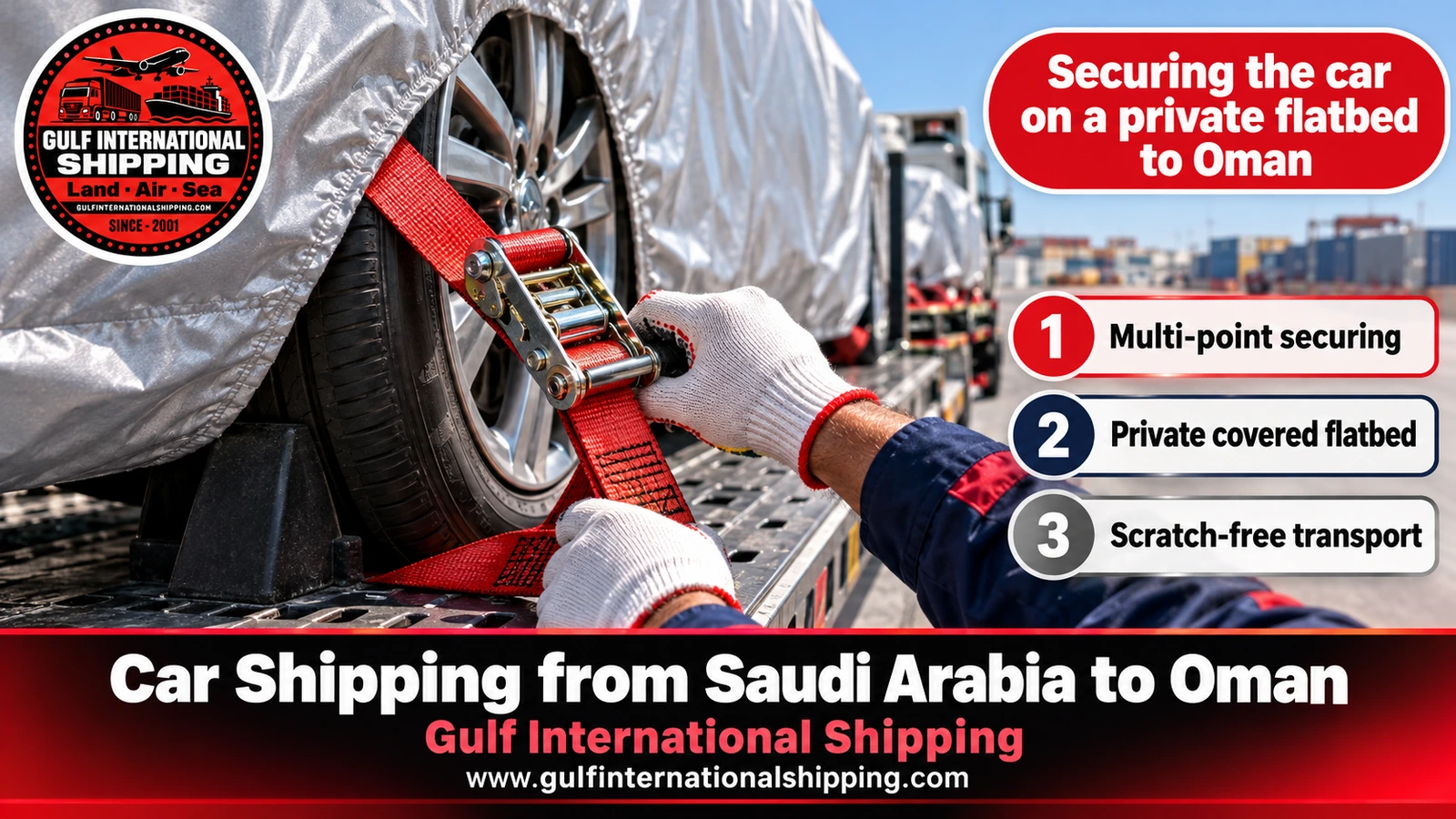
The enclosed transporter is a sealed box that protects the car from blown sand, flying gravel and direct sun, and we use it for luxury, sports and classic cars. The car is covered and the straps go around the tyres themselves, keeping the body, suspension and paint free of any tension. It starts at SAR 4,140.
Our rule of thumb for customers is simple: if your car is valuable or its paint is delicate, the price gap between a shared and an enclosed carrier is far smaller than the cost of repairing a scratch or a cracked windscreen after a 1,400 km-plus trip with hundreds of kilometres through sand.
How much duty and VAT does a car pay in Oman?
Oman works the charge out in two stages. First, customs take 5% of the landed value (car, freight and insurance) as duty; then that duty is added to the value and 5% VAT is applied to the total. The exemption for personal effects and used household goods does not extend to vehicles, so even a new resident normally pays the duty and VAT on their car.
This is an illustration only: Omani customs value the car in their own way, and their figure may differ from the purchase price you have in mind. Some recently registered cars moved between GCC states may be treated differently through the clearing (muqasa) arrangement, but that is assessed case by case, so do not build your budget on it until the clearing agent has confirmed it.
Car shipping times from Saudi cities to Oman
Cars from the western cities usually travel to Riyadh and then south to Haradh and the Batha junction, before covering the 564 km Saudi desert section. A dedicated flatbed is often quicker than a shared carrier because it does not wait to fill up. Either way, the longest wait tends to be at the border and in completing Bayan, not on the road. The full details of the crossing and its hours are in the Empty Quarter border crossing guide.
Registering the car in Oman after it arrives
Once the car has crossed and Bayan formalities are complete, registration with the Royal Oman Police begins. We time the arrival so that the receiver is ready with the papers and the car does not sit in a yard for days for no reason.
- Insurance: take out Omani insurance on the car before it arrives; it is usually required at least a day in advance
- Owner’s documents: proof of ownership, passport and visa copy, or the Omani ID or resident card
- Export certificate: the original issued by Saudi traffic, together with the customs declaration
- Technical inspection: cars older than 3 years may need a technical inspection before licensing
- Registration time: usually one to two working days once the paperwork is complete
- Common sticking points: window tint beyond the permitted limit and matte paint can usually prevent licensing

Handover happens at the receiver’s gate in Muscat, Seeb, Al Khuwair, Al Mawaleh and beyond, or to a nearby open space if the street is too tight for the carrier. We remove the cover in front of you, compare the car’s condition with the photos we took in the Kingdom before loading, and then you sign for it.
Electric cars, classics and motorcycles
Electric cars ship under the same age and export conditions, but we ask for the battery to be at roughly a quarter to half charge, set it to the transport mode the manufacturer specifies, and prefer an enclosed transporter or dedicated flatbed to shield it from long hours of heat.
Classic cars follow a different track under Omani rules: at 30 years the Directorate General of Traffic must sign off, and anything past 50 counts as a classic. These cars travel only in an enclosed transporter, and we price them once we know their condition and value.
Motorcycles ship in a crate or strapped inside a closed truck, and small bikes under 70 cc need a permit from Oman’s Ministry of Commerce under the rules. Send us the make and engine size for a price.
Should I drive my car to Oman or ship it?
If you are visiting Oman and will come back with your car, that is not an import but a temporary entry. You will normally need a customs transit document (triptyque/carnet), valid Omani insurance, the original istimara, and, for a financed car, the lender’s no-objection letter. In that case the age and export conditions do not apply in the same way.
If you are moving to live there and the car will stay in Oman, shipping is usually the better choice for practical reasons: 1,400 km or more of driving, including hundreds of kilometres of sand with no towns, and the same import formalities in any case. With shipping, you fly and the car is waiting for you.
Air freight alongside your car: keys, papers and spare parts
We do not fly cars to Oman; the cost makes no sense next to road transport. Air freight does help with what goes with the car, though: the spare key, original papers the receiver may need before the carrier arrives, spare parts and special tyres, and belongings that must not be left inside the car. Nonstop flights carry them to Muscat from the Riyadh, Jeddah, Dammam and Madinah airports, and from Taif according to the airline schedule; the kilo starts at SAR 41 and delivery to the receiver’s address takes two to three days. Details are in air freight from Saudi Arabia to Oman.
Getting your car ready for loading
- Wash the car before handover so any scratches show up clearly in the condition photos
- Leave about a quarter tank of fuel; the car does not need more on a carrier
- Take out all personal belongings, because customs inspect the car and expect it to be empty
- Remove detachable exterior accessories such as bike racks and roof boxes
- Switch off the alarm or tell us how to disable it
- Hand over a single key; hold on to the spare or fly it separately
Mistakes that delay your car or cost you more
- Shipping a car 7 years old or more: private cars are only accepted below the 7-year mark
- Relying on the GCC clearance certificate: Oman wants the export certificate issued where the car is registered
- Forgetting the finance release: a financed car cannot be exported without the lender’s consent
- Assuming a new resident’s car is exempt: the exemption covers belongings and furniture, not vehicles
- Leaving things in the boot: they slow inspection and may be treated as goods
- Leaving Omani insurance too late: the car cannot be registered without Omani cover
What makes Gulf International Shipping a safe pair of hands for your car?
Eligibility checked first
Age and paperwork are verified before you pay anything, avoiding a turn-back at the crossing.
Export done before loading
The car does not move until the Absher export and the Fasah declaration are complete.
Three carrier types
Shared for economy, a dedicated flatbed for speed, enclosed for luxury and classics.
Strapped by the wheels
Ratchet straps on the tyres and a protective cover, with no strain on the body.
Photo record
Photos before loading and at delivery so you can compare the car’s condition yourself.
Delivered to the door
In Muscat, Sohar, Nizwa, Salalah and other Omani cities.
Find out what shipping your car to Oman will cost
Send a photo of the istimara with the pickup and delivery cities, and we will confirm eligibility, the transport price and the earliest date.
Related guides on shipping cars to Oman
- Shipping company from Saudi Arabia to Oman: every type of shipment from every city
- Shipping from Riyadh to Oman: where most carriers start
- Land freight from Dammam to Oman: the lowest starting rate for cars
- Shipping from Jeddah to Oman: timing from the west
- Oman used household goods customs: for those moving house as well as a car
- Shipping prices from Saudi Arabia to Oman: tables for every city
- car shipping service, customs clearance service and all destinations