
The Empty Quarter border crossing to Oman is the only direct land gateway between the two countries, facing the Omani post of Ramlat Khaylah near the wilayat of Ibri. Saudi customs let a truck through once its export declaration is in and its Fasah appointment has been reserved; the Omani customs declaration is then cleared on the Bayan system through a licensed clearing agent, and the truck drives the final 161 km to Ibri. Freight moves through at any hour, and the goods yard was built to process close to 966 lorries daily. Shipments loaded by Gulf International Shipping in Riyadh or the Eastern Province reach Muscat through it within three to five working days, with prices starting at SAR 46 per small carton, SAR 1,840 per car and SAR 8,280 for a truck carrying a 20 ft container load.
Most of what has been written about the Empty Quarter crossing is aimed at people driving their own cars: where the fuel stops are, how many hours the road takes, which papers a family needs. This page is different. It is written for anyone sending a shipment, whether household furniture, trade goods or a car. A truck does not cross the way a traveller’s car does: it uses its own lanes, carries different papers and has a slot it must keep, and any gap in its file can mean hours or days of waiting in the desert.
Quick facts
- Location: deep in the Rub Al Khali, administratively part of the Eastern Province, opposite the Ramlat Khaylah post near Ibri in Al Dhahirah
- Road: roughly 725 km end to end: 564 km of Saudi highway after the Haradh turn-off, and 161 km of Omani road down to Ibri
- Capacity: goods yard sized for some 966 lorries every day, passenger side for some 1,700 cars
- Hours: around the clock for commercial traffic; waiting time depends on congestion
- Saudi side: export declaration and a pre-booked truck slot on Fasah
- Omani side: clearance on Bayan through a licensed agent, with inspection based on risk criteria
- Transit and price: 3–5 working days to Muscat from Riyadh and the Eastern Province; cartons from SAR 46, cars from SAR 1,840
Route: Haradh → Shaybah field → Empty Quarter crossing → Ramlat Khaylah → Ibri → Muscat · 0568829975
Where is the Empty Quarter crossing and how do trucks reach it?
The crossing sits in the heart of the Rub Al Khali desert in the south-east of the Kingdom and falls administratively under the Eastern Province. The road to it begins at the Batha–Haradh road junction, only about 25 km from the Batha border post with the UAE, and then heads south and east across the sands. The Saudi road was built in two stages: the first runs 319 km from the junction to the Shaybah oil field, the second 246 km from Shaybah to the border, with rest areas for trucks and cars along the way.
Those figures explain why Ibri, Yanqul and Dhank are the first delivery stops after the border, and why a shipment bound for Salalah needs extra days: from the border the truck usually heads south through Adam, Haima and Thumrait, over far longer distances than the run to Muscat.
The Empty Quarter crossing in numbers
Saudipedia and the Saudi Press Agency publish official figures on the crossing and its road, and those are what we plan our truck schedules around:
For a shipper, the figure that matters most is cargo-yard capacity. When truck numbers approach it, as they do before holidays and peak seasons, the wait gets longer. So when your dates allow, we prefer to move large shipments on quieter days.
Which Saudi cities feed into the crossing?
Every road to Oman converges on the Batha–Haradh junction; what differs between cities is the drive to that junction. From Riyadh the truck usually runs down through Al Kharj to Haradh; from Dammam and Khobar through Al Ahsa and Hofuf; from Jeddah, Makkah and Taif east to Riyadh first; from Madinah through Qassim then Riyadh; and from Tabuk through Hail or Qassim then Riyadh.
Notice that Dammam is not much closer to Muscat than Riyadh, as many people assume, because both cities join the same road. The real difference between cities is the distance to Haradh; beyond it, the road is the same for everyone. For your city’s details, see shipping company from Riyadh to Oman, land freight from Dammam to Oman or shipping company from Jeddah to Oman.
On the Saudi side: the export declaration and the Fasah slot
Before the truck leaves your city, the broker enters the export declaration on Fasah, the online system run by ZATCA (the Saudi Zakat, Tax and Customs Authority). Then comes the part many people do not know about: the authority requires the carrier to book an electronic appointment for the truck on Fasah before it reaches any land border, and to arrive within a time window close to that appointment. A truck that turns up with no slot, or far outside its window, can be sent back to wait.
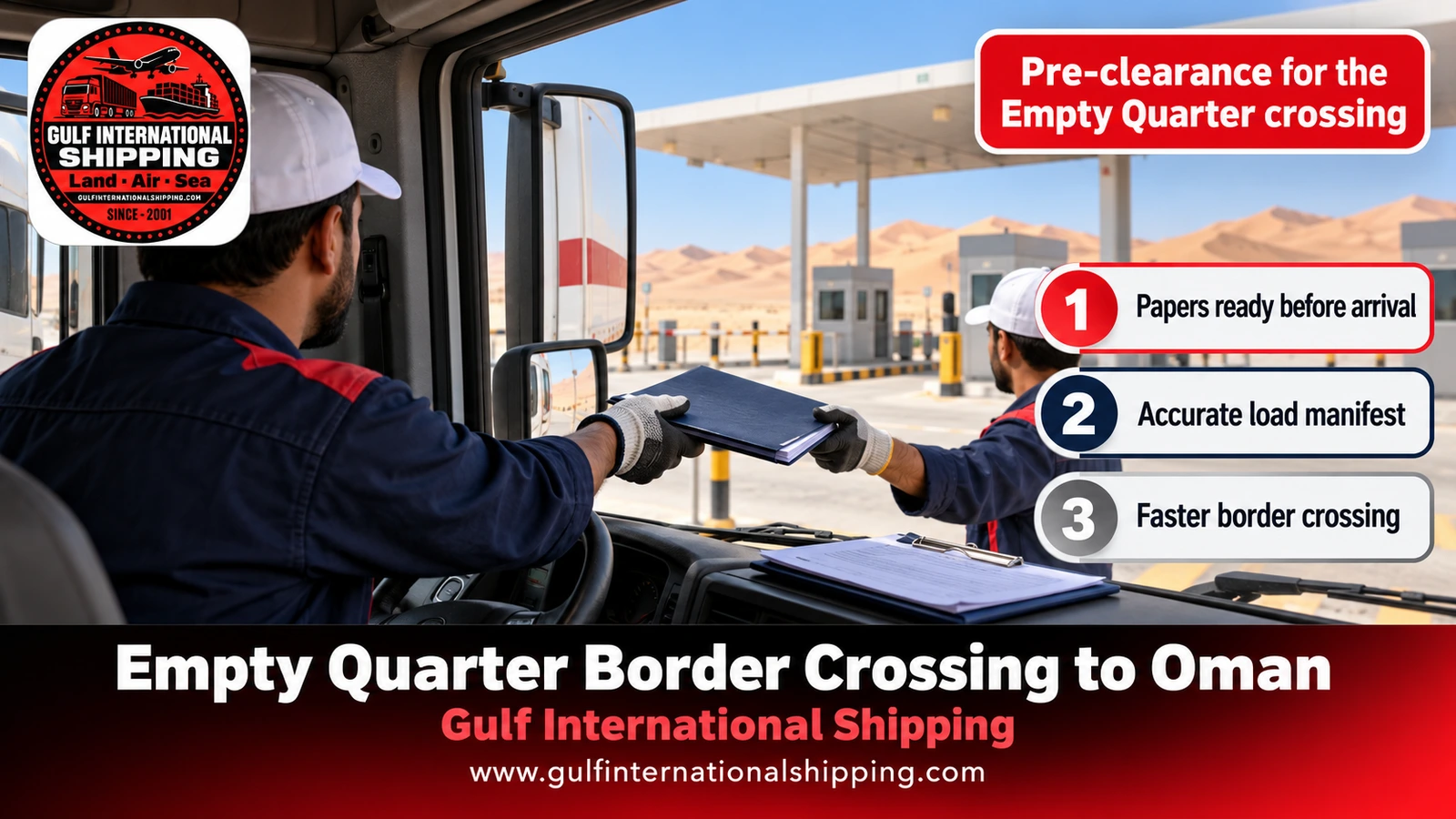
That is why we only book the slot once loading and paperwork are complete, and we calculate the driving time from the pickup city to the border carefully. A truck from Jeddah needs at least two days to reach the crossing and one from Riyadh about a day, and we book the slot on that basis with a margin for rest and refuelling.
- Household furniture: an electronic authorisation from the owner to the company on Fasah, a copy of the ID or iqama, and the inventory.
- Cars: the export certificate from Absher, the registration (istimara), and a bank letter if the car is financed.
- Goods: trade invoice, packing list, origin certificate and a copy of the CR.
On the Omani side: the Bayan system and the clearing agent
After leaving the Saudi side, the truck moves up to the Ramlat Khaylah post. Here a clearing agent licensed in Oman files the declaration on Bayan, the Omani customs electronic system, together with the invoices, the inventory and the receiver’s papers. Omani customs inspect shipments according to risk criteria, and household furniture is usually inspected in full.
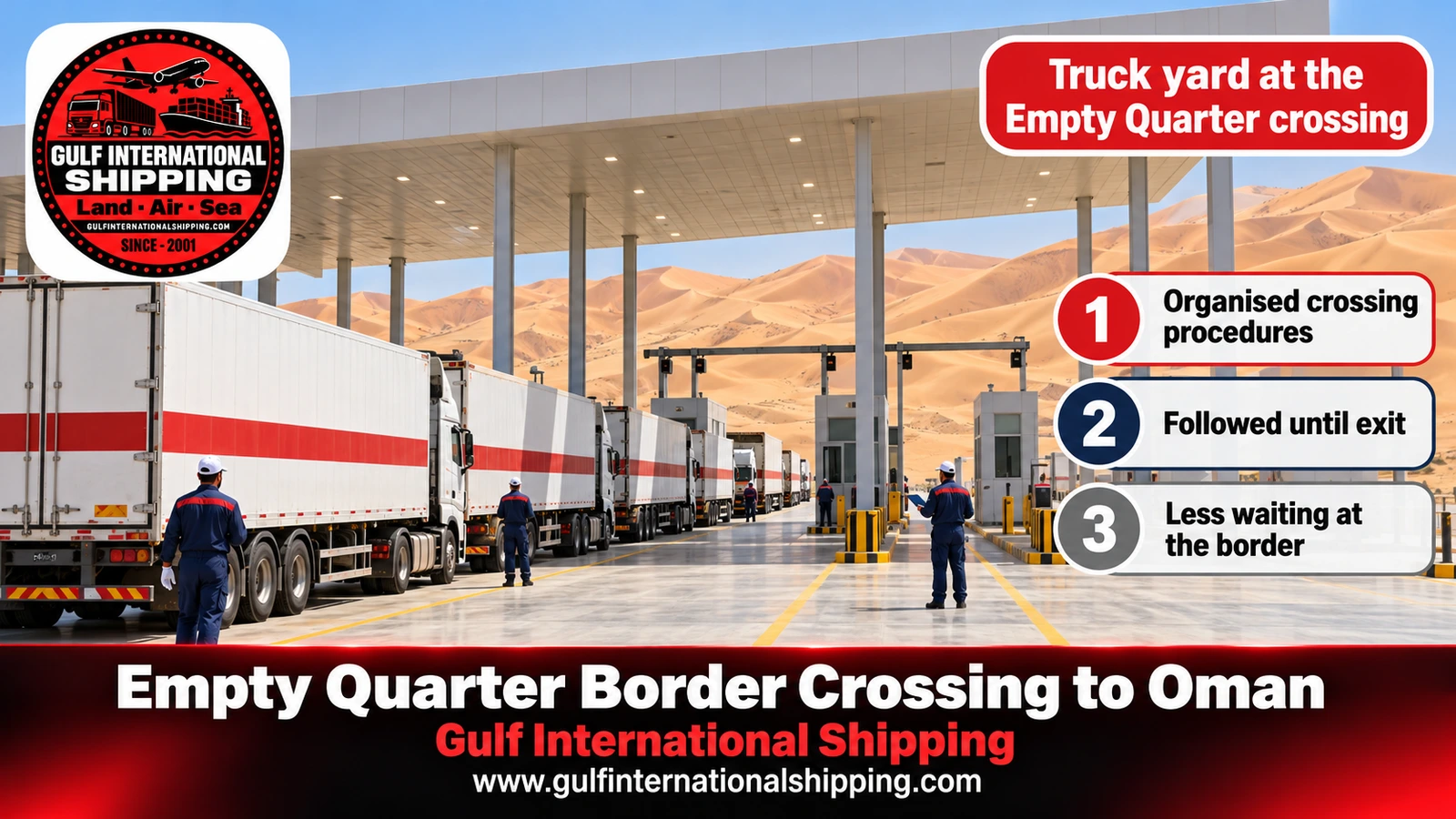
This is the point where any charges are assessed: 5% customs duty on new goods of non-GCC origin, and 5% VAT on the value plus freight and duty. Goods made in Saudi Arabia are spared customs duty when the GCC certificate of origin travels with them, and the used furniture of new residents and returning Omanis is exempt under conditions. Sealed loads can also travel under TIR carnets, a convention Oman applies, which trims the paperwork at the post. For the furniture exemption in detail, see Oman used household goods customs.
Fasah in Saudi Arabia, Bayan in Oman
The two names get mixed up in many adverts. Fasah is the Saudi customs platform for exports and border appointments; Bayan is the Omani customs system for imports. Any mention of systems called “Al Nadeeb” or “Mersal” on this route has nothing to do with Omani customs.
The truck file: what the driver must carry
We put this file together in our office before loading and send an electronic copy to the clearing agent on the Omani side, so the declaration can be prepared before the truck arrives. That simple step saves hours of waiting in the yard.
How many hours does a truck spend at the Empty Quarter crossing?
There is no fixed figure. A truck that arrives on its slot with a complete file and a simple commercial load can clear both sides within hours. A truck carrying household furniture needs longer for a full inspection, and if there are books or films on board, those cartons may be referred to Oman’s Ministry of Information for review. Waits generally grow in the days before holidays and peak seasons, when the cargo yard fills up.
The factors that decide crossing time, in order of importance, are: a complete file and an accurate inventory, keeping to the Fasah slot, the type of load, and how many trucks are queuing that day. The first three are in our hands and yours, so that is where we put our effort.
The road itself: what it means for your shipment
Between Haradh and the border lie hundreds of kilometres of dunes, and services are much further apart than on highways near the cities. That calls for planning a shipping company does not need on other routes:
- Fuel and rest: we plan refuelling and rest points before the truck sets off, rather than leaving them to chance.
- Heat: a closed truck box gets very hot in summer, so we wrap furniture in insulating layers and keep sensitive appliances away from the box walls.
- Dust: fine sand gets through any gap, so we seal the edges of the wrapping tightly.
- Coverage: mobile signal drops on parts of the road, and the trackers in our trucks give a last known position.
- Food and dates: we use refrigerated trucks for anything that needs a steady temperature.
- Cars: an enclosed carrier shields luxury cars from sand and sun along the whole road.
The UAE route: when do we use it instead of the Empty Quarter?
Before this road opened, trucks crossed from Batha to Ghuwaifat in the UAE, then left through one of the Emirati–Omani posts such as Khatmat Malaha, Al Wajajah near Hatta, or Hafeet. That route still exists, but it adds a transit declaration in the UAE, meaning a third customs authority. Gulf International Shipping uses it in three cases only: delivery to Musandam governorate (Khasab, Bukha and Dibba), cut off from the rest of Oman by Emirati land; heavy congestion at the Empty Quarter crossing; and consolidated GCC loads that pass through the Emirates anyway. Otherwise the Empty Quarter remains the shorter and simpler road.
Wrong names that keep coming up for the Oman border
- “Al Ruqi crossing”: a post on the Kuwaiti border with no connection to the Oman road.
- “Salwa crossing”: the Kingdom’s gateway to Qatar.
- “Ghuwaifat” as an Omani post: Ghuwaifat is the Emirati post opposite Batha.
- “Umm Al Zumul crossing”: we do not use it on our Oman routes, and we found nothing confirming it is used for this purpose.
- “Bayan” on the Saudi side: the Saudi system is Fasah; Bayan is the Omani one.
If you see any of these names in a shipping company’s offer for Oman, ask exactly which route its truck takes before handing over your belongings.
Approximate prices for shipping to Oman via the Empty Quarter crossing
These rates come from Gulf International Shipping’s table for shipments from the Kingdom to Oman and cover the whole road to the address plus the Saudi-side border formalities. The first figure is our starting point, the second the usual market ceiling.
Note: count 3–5 working days from loading to delivery in Muscat for Riyadh and Eastern Province shipments, about a week (5–7 days) from the western cities and Madinah, and 6–8 days from Tabuk, adding roughly two days for Salalah; air cargo needs 48–72 hours from pickup to handover.
Other rates: online-store orders up to 5 kg have a starting price of SAR 41 for Muscat and SAR 50 for Salalah, jumbo cartons up to 30 kg start at SAR 138, a luxury car in an enclosed carrier at SAR 4,140, and a whole house at SAR 3,220. Clearance fees on the Omani side depend on the type of shipment, so ask for your quote. Full tables are in shipping prices from Saudi Arabia to Oman.
Air freight: the alternative when a shipment cannot take the desert road
Some shipments do not suit days on the road: original papers, a machine part that has stopped a factory line, permitted medicines that need controlled temperatures, and trade samples. For these we use air freight to Muscat International Airport, where Oman Air runs nonstop flights from Riyadh, Jeddah, Dammam and Madinah and direct flights from Taif subject to the airline schedule, and SalamAir serves several Saudi airports and also flies to Salalah. Flying time is about two and a quarter hours from the capital and a little over three hours from Jeddah.
Our air freight starts at SAR 41 a kilo, and collection to delivery takes two to three days depending on flights and clearance at Muscat airport. Billing uses whichever is higher, scale weight or dimensional weight. Details in air freight from Saudi Arabia to Oman.
Your shipment through the Empty Quarter crossing, step by step
- 1Pricing and truck type
you send us the items and the Omani destination; we choose shared or dedicated and set the cost. - 2Preparing the file
we gather the papers for your type of shipment and write the inventory as we pack. - 3Loading and export
we load the truck and register the export declaration on Fasah. - 4Booking the border slot
we book the truck’s slot at the Empty Quarter crossing based on the drive time from your city. - 5Crossing and Omani clearance
the agent files on Bayan and stays with the shipment through inspection to release. - 6On to your city
the truck continues to Ibri, then Muscat, Al Batinah or Dhofar, and we update you at every stage.
Send your shipment through the Empty Quarter with a ready file
Tell us what you are shipping, your Saudi city and the Omani destination, and you will get a price plus the date of the next truck.
Related Oman guides
- Shipping company from Saudi Arabia to Oman: the full guide to transit times, prices and services
- Oman used household goods customs: exemption conditions and papers
- Car shipping from Saudi Arabia to Oman: age limit and export certificate
- Goods shipping from Saudi Arabia to Oman: certificates of origin and full loads
- Shipping company from Makkah to Oman, shipping company from Madinah to Oman, shipping company from Taif to Oman and shipping company from Tabuk to Oman
- All destinations from Saudi Arabia, land freight service and customs clearance service