

Morocco waives duty on returning residents’ household goods: when a Moroccan resettles at home permanently, second-hand furnishings, clothes and other personal belongings, plus one appliance per category, pass customs without charge, up to the limit customs applies, as a one-time right for the household, backed by a certificate of change of residence and an itemised list that is dated and signed. Anything new is charged customs duty and 20% VAT. Gulf International Shipping packs your home in whichever Saudi city you live in and puts it on a vessel from Jeddah towards Tanger Med or Casablanca, reaching the family address in 20–34 days; a bedroom costs SAR 1,380 and up, a full home SAR 3,680 and up, and your own 20 ft container SAR 4,140 and up.
Many Moroccan families who have spent years in Riyadh, Jeddah or Dammam put off moving their furniture for fear of customs, or sell it for half its value assuming shipping will cost more than buying new in Morocco. In fact Moroccan law gives permanent returnees a clear exemption, but ties it to papers and deadlines that cost you the exemption if missed. This guide explains who qualifies, what is covered and what is not, how to write the inventory, when the container must arrive and what happens at inspection, so your belongings reach the family home without surprises. The conditions described here are worth double-checking with Moroccan customs before you ship, as they can be updated.
At a glance
- Who qualifies: a Moroccan living abroad who returns to settle in Morocco permanently, whether employee, trader or professional
- What is exempt: used furniture, clothing and personal effects, and one appliance of each type, within the approved ceiling
- How often: once per family, not once per family member
- Key document: the certificate of change of residence in original, obtained from the embassy in Riyadh or the consulate in Jeddah, together with your signed list
- Time limit: goods should travel with the move; a follow-up consignment is accepted if it lands before the certificate is six months old and clears at the first office
- New items: pay customs duty plus 20% VAT
- Shipping prices: SAR 1,380 and up for a bedroom, SAR 3,680 and up for a whole home in a shared box, SAR 4,140 and up for a private 20 ft container
Route: your Saudi home → Jeddah port → Tanger Med or Casablanca → the family home · Time: 20–34 days · Contact: 0568829975
Who qualifies for the used-furniture exemption when returning to Morocco?
The exemption is for a Moroccan living abroad who ends their residence in the country where they live, such as Saudi Arabia, and comes back to settle in Morocco. It does not matter whether you are a company employee, a teacher, a doctor, a trader or a craftsman: what counts is that the move is permanent and the goods are for your own and your family’s use, not for sale. That is exactly what the change-of-residence certificate proves, stating your occupation and the date of your move.
The exemption is granted to a household once. If the husband ships the family furniture under the final-return exemption, the wife cannot claim a second exemption for other things from the same home months later. Nor does it apply to someone who spends the summer holiday in Morocco and then returns to work in the Kingdom; that person is a traveller and different rules apply. So our first question on the phone is: is your return permanent, and when are you leaving the Kingdom? The whole paperwork plan is built on the answer.
Permanent returnee versus holiday traveller: two different rules
When Moroccans abroad visit home they may bring some personal, non-trade goods free of duty to a set value, yet that concession excludes household furniture, home appliances, TVs or motorcycles. So don’t try to bring your home in as traveller’s goods; the correct route for household furniture is the final-return exemption, with its certificate and inventory.
Which items are duty-free and which pay duty?
The general rule is that used goods serving your home are exempt, while new, duplicated or commercial goods pay. The items are normally expected to have been owned and used for at least six months before the move. The table summarises the usual treatment of what returnees most often bring:
Anything above the approved ceiling for non-commercial goods pays duty on the excess. Moroccan customs sets that ceiling and raises it from time to time, so don’t rely on a figure from an old forum post; we check it with you before shipping. If you have an appliance you bought new a few weeks before leaving, it is better to list it openly as new, because hiding it among used items can lead the inspector to re-examine the whole container.
Documents required for the returning residents’ exemption
An exemption file is made up of papers issued in Saudi Arabia and others the consignee presents in Morocco. This table sorts them by source:
In Saudi Arabia we file the export on Fasah using a copy of your iqama or ID and the list of contents. A practical tip: apply for your residence-change certificate at the embassy or consulate a few weeks before the packers arrive, because the container will not wait at the Moroccan port, and missing papers are the most common reason for delayed release.
How to write an inventory that Moroccan customs accepts
The inventory is the heart of the exemption file, and the inspector at the port compares what they see with what it says. A good inventory follows carton and item numbers, not just rooms, and every line has a number, a description, a quantity, a condition and an approximate value. The value is not the original purchase price but what the used item is worth today, so be realistic. We photograph every piece before wrapping it and write its number on the packaging, so the list matches the container exactly. Here is how the lines look:
Tip: give new items their own line
If there is a new appliance or piece among your things, list it on a separate line marked “new” and attach the invoice. That line alone pays duty and VAT, and the rest goes through without question.
When must the furniture arrive? The six-month window and the second lot
The exemption assumes your furniture enters Morocco with your move and that household goods travel in one batch. There is, however, room for a second consignment, on three conditions: everything in it was listed on the original inventory, it clears through the office that handled the first, and it lands before six months have passed from the certificate’s issue date. That is handy if you send the children’s things and books first, then the large furniture once your Saudi lease ends.
So plan with a calendar. A container from the Kingdom needs 20–34 days to reach a Moroccan doorstep, depending on where it is loaded, and LCL cargo may sit for as long as a week waiting for its box to fill. If the certificate is issued today, you have time for two lots, as long as the second is not left to the final month. And once the container lands, don’t leave the goods at the port: after 45 days in customs custody, cargo is classed as abandoned, so our exemption file is ready before the vessel even berths.
What happens at the customs inspection in Tanger Med or Casablanca?
Once the box is discharged, our broker submits the entry for the consignee with the exemption papers attached, and the customs office chooses whether to examine it. At inspection the container is opened in the examination area and the officer picks particular cartons to check against the list, and may ask to see the appliances or any piece that looks new. That is why we load the container so the cartons asked for are easy to pull out and put back, with a copy of the list by the doors.
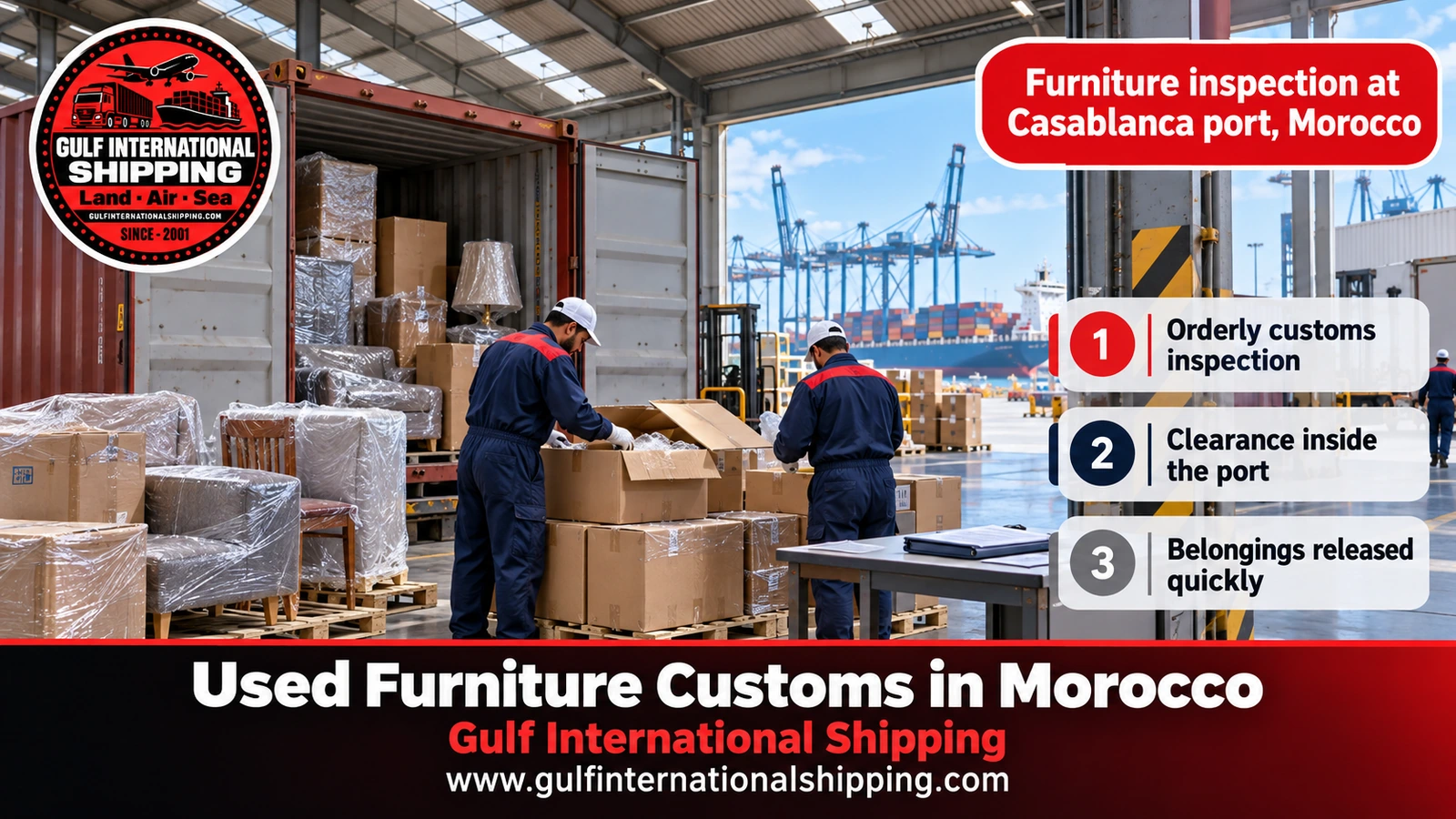
If the goods match the list and are used, the exemption applies and the container is released. If there are new pieces or goods above the ceiling, duty and VAT are calculated on those alone; the consignee pays and the container is released. The consignee can attend the inspection in person or authorise our agent. When nothing is missing from the file, release normally comes within two to five days.
Freight costs for a returnee’s used furniture
The exemption only removes Moroccan duty; freight is a separate bill. Our minimum prices, each pitched under the cheapest rate advertised by other Morocco shippers for that item, are:
Note: depending on where in the Kingdom it is loaded, returnee furniture needs 20–34 days to reach the family home, and urgent items by air 3–7 days. The figures are for Hejaz towns; from Riyadh, Tabuk and Dammam they rise by the cost of trucking to the port in Jeddah. To compare cities see shipping prices from Saudi Arabia to Morocco, and for packing and reassembly read furniture moving from Saudi Arabia to Morocco.
Is the car included in the furniture exemption?
No. The exemption covers household goods only; vehicles fall under a separate regime. Moroccan registration is closed to imported passenger cars older than five years from first registration, apart from narrow cases such as retirees coming home, who are typically allowed one under ten. Returning residents receive a duty cut that falls as the car gets older, and anyone past sixty with over a decade abroad has a single, generous lifetime reduction, provided the car is kept unsold for the period customs sets. Confirm these points before the car ships.
In practice the car can travel in the same container as the furniture if it is a 40 ft box, or in its own 20 ft container. Our freight for a passenger car to the Moroccan quay starts at SAR 4,600; Moroccan duties come on top of that. Details are in car shipping from Saudi Arabia to Morocco.
Air freight for urgent items when you move back to Morocco
Not everything you bring home can wait for the container. Degree certificates, children’s school records, prescribed medicines and the laptop you work on are all needed in your first week in Morocco. Those go in an express air parcel, priced from SAR 1,655, on the non-stop services out of Riyadh or Jeddah to Casablanca, or Jeddah to Rabat, and arrive within 3–7 days. Kilo pricing varies with weight and size; message us on WhatsApp for a figure.
Bear in mind that an air parcel clears Moroccan customs at the airport just like a container, so describe its contents clearly and don’t put in new devices in quantities that could look commercial. For more, read air freight from Saudi Arabia to Morocco.
Steps to move your home from Saudi Arabia to Morocco under the returnee exemption
- 1Contact us early
Call or message 0568829975 with the date you leave, where you live now and where the family home is. - 2Get the residence-change certificate
Apply at the embassy in Riyadh or the consulate in Jeddah a few weeks ahead of packing day. - 3Survey and inventory
We visit or survey by video, recommend shared or full container, and start the inventory. - 4Packing and numbering
Sea-grade packing for every piece, numbered and photographed cartons that match the list. - 5Export and sailing
We truck the goods to Jeddah Islamic Port, file the Fasah declaration, and the container sails via Suez. - 6Clearance under the exemption
Our broker hands the exemption file to the customs office at the arrival port and stays with the inspection until release. - 7Delivery and assembly
We deliver to the family home and reassemble beds and wardrobes.
Mistakes that lose the exemption or delay your furniture
- Shipping before the certificate is issued: a container that arrives with an incomplete file waits at the port while storage charges build up.
- A vague list like “household items”: the inspector needs numbers and descriptions, and a vague list means a longer examination.
- Hiding new pieces among used ones: it costs you the inspector’s trust and can trigger a full examination.
- Two appliances of the same type: the second pays duty, so decide before shipping whether it is worth it.
- Leaving the second lot too late: after six months from the certificate date it enters as an ordinary import.
- Clearing the second lot at a different office: it must go through the same customs office as the first.
- Counting the car in: the car is not exempt with the furniture and has its own age rules.
After release: delivery to the family home
Once the container leaves customs our truck takes it to your address, whether a flat in Rabat or Casablanca or a traditional house in the old medina of Fes or Meknes, where the lanes are too narrow for a large truck. In that case we transfer the goods to a smaller vehicle at the medina gate and carry them by hand to the door. Marrakech, Agadir, Oujda and the southern cities add 2–4 days to delivery compared with Tangier, Rabat and Casablanca.
For the full picture of the sea route and transit times from every Saudi city, read shipping company from Saudi Arabia to Morocco and sea freight from Saudi Arabia to Morocco.
Start your move home to Morocco
Tell us when you are going back, share a few pictures of the house and name the town; we reply with a price, a paperwork checklist and the next departure.
Related Morocco articles
- Shipping company from Saudi Arabia to Morocco and furniture moving from Saudi Arabia to Morocco
- Car shipping to Morocco, sea freight to Morocco and cartons and parcels to Morocco
- By city: Riyadh, Jeddah, Dammam, Makkah, Madinah, Taif, Tabuk
- International furniture moving, customs clearance and all destinations