
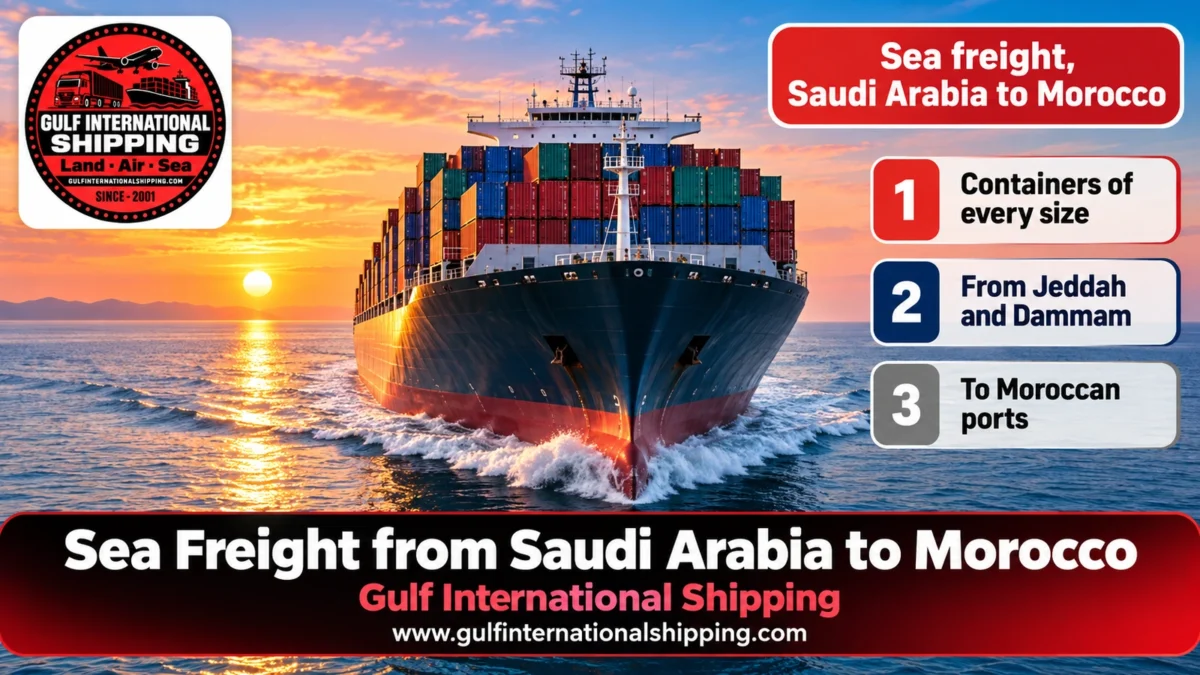
Sea freight from Saudi Arabia to Morocco begins on the quay at Jeddah Islamic Port: the box goes aboard a vessel that climbs the Red Sea, passes through Suez and crosses the Mediterranean, berthing at Tanger Med roughly ten days later, where it is either cleared or sent on to Casablanca. From pickup to delivery, allow between 20 and 34 days, according to the Saudi city where the goods are loaded. Gulf International Shipping charges from SAR 780 for each shared cubic metre, from SAR 4,140 for a box of 20 ft and from SAR 6,440 for one of 40 ft, and from SAR 4,600 to carry a passenger car in a sealed container.
This is a practical guide for anyone who wants to understand sea freight to Morocco before paying a single riyal: which port the container leaves from, where it calls, how many days each stage takes, how a cubic metre is measured, when booking a whole box is cheaper than sharing, which documents travel with it and what awaits it at the Moroccan port. We wrote it from the shipments we prepare every week from Riyadh, Jeddah, Dammam and other cities, as a reference for anyone sending furniture, a car or commercial goods.
At a glance
- Loading port: Jeddah Islamic Port for every Saudi city; cargo from Riyadh, the Eastern Province and Tabuk reaches it by truck
- Arrival ports: Tanger Med for the north and most containers, Casablanca for the centre, and Agadir for the south when the schedule allows
- Sailing time: close to ten days between the Jeddah quay and the Tanger Med quay, through Suez
- Door-to-door time: from 20 days (Hejaz loads) up to 34 (Eastern Province loads); a shared box may wait as long as a week to fill
- Shared freight (LCL): from SAR 780 per cubic metre for cartons, bedrooms and small shipments
- Full containers (FCL): 20 ft (about 33 m³) from SAR 4,140 and 40 ft (about 67 m³) from SAR 6,440
- Cars: only cars younger than five years, strapped in a sealed 20 ft box, SAR 4,600 and up
Route: Jeddah → north through the Red Sea → Suez → across the Mediterranean → Tanger Med · Sailing: about 10 days · Contact: 0568829975
Why ship to Morocco by sea?
Because the sea is the only route that can take a household, a car or commercial goods at a sensible cost. No truck line connects the Kingdom with Morocco, and air freight is charged by the kilo or volumetric weight, so flying a bedroom set costs several times what it is worth. A container, by contrast, is priced by volume, and a heavy carton and a big, light sofa are treated alike. That is why anything beyond a few cartons usually goes to Morocco by sea, leaving the air for urgent and small items.
Which Saudi port do shipments to Morocco sail from?
Our Morocco shipments sail from Jeddah Islamic Port, the largest port on the Red Sea and the closest to the Suez Canal, where the services bound for the Mediterranean and North Africa start. Hejaz cities are close by, so their goods arrive the same day, while Riyadh, Tabuk and the Eastern Province involve a longer truck run. Loads from Dammam, Khobar and Al-Ahsa therefore cross the Kingdom by truck and board ship in Jeddah, where the westbound service starts, giving you a shorter time at sea and an earlier departure.
The truck that carries your goods to the port is closed, and it unloads at the consolidation warehouse for shared freight or straight into the dedicated container for a full load. In some cases we send the empty container to your home or warehouse in Jeddah to be loaded there and returned to the port sealed. For city details read shipping company from Jeddah to Morocco, shipping company from Riyadh to Morocco and shipping company from Dammam to Morocco.
The container’s voyage from Jeddah to Tanger Med via Suez
Once the Jeddah container terminal receives your box before the booking cut-off, it is lifted aboard on sailing day. For two or three days the vessel runs north, reaching the Gulf of Suez, joins the canal convoy, usually calls at Port Said at the Mediterranean entrance, then crosses the Mediterranean from east to west to Tanger Med at the Strait of Gibraltar. Quay to quay, Jeddah to Tangier takes about 10 days on the direct Suez service.
There is currently no non-stop Saudi–Moroccan line, so some containers pass through an intermediate Mediterranean port where they are moved to another vessel, which adds days. Before booking we compare the Suez sailings out of Jeddah and pick the one with the earliest date and fewest calls, then pass you the container and bill of lading numbers so you can track the vessel on the line’s own site.
Breaking down the transit time
Put together, Jeddah, Makkah and Taif loads are delivered in northern Morocco, Rabat or Casablanca after about 20–30 days, from Madinah in 21–31 days, from Riyadh and Tabuk in 22–32 days, and from Dammam and the Eastern Province in 23–34 days. Homes in Marrakech, Agadir, Oujda or the far south need a further two to four days. Vessel timetables, Red Sea conditions and the pace of clearance can all nudge these figures.
Tanger Med: what happens to your container on arrival?
Tanger Med is Morocco’s main container gateway, linked to a large number of ports worldwide. When the ship berths, your container is discharged to the yard and an arrival notice goes to the customs broker. If your destination is in the north, Fes, Meknes or Rabat, the container is usually cleared in Tangier and trucked to your address. For Casablanca and points south, we compare clearing in Tangier and trucking against a sea relay to Casablanca port.
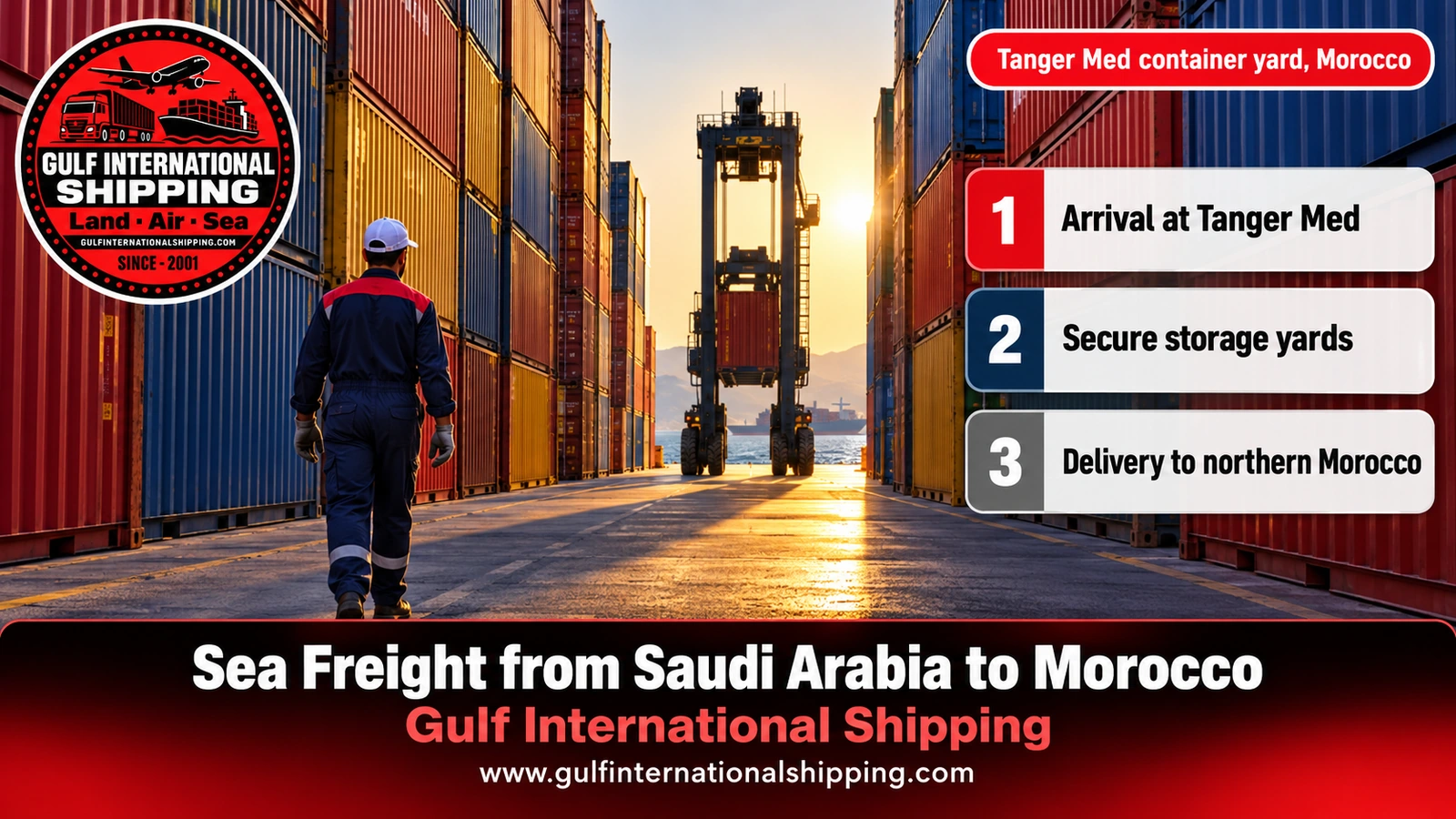
Once in the port yard, the free days granted by the carrier and the port start to run, after which storage and detention charges apply. So the consignee’s file is ready before the vessel docks, and the box does not linger in the yard. Moroccan customs also caps its custody at 45 days, after which cargo is classed as abandoned; fast clearance guards your money as well as your schedule.
Arriving at Casablanca and Agadir
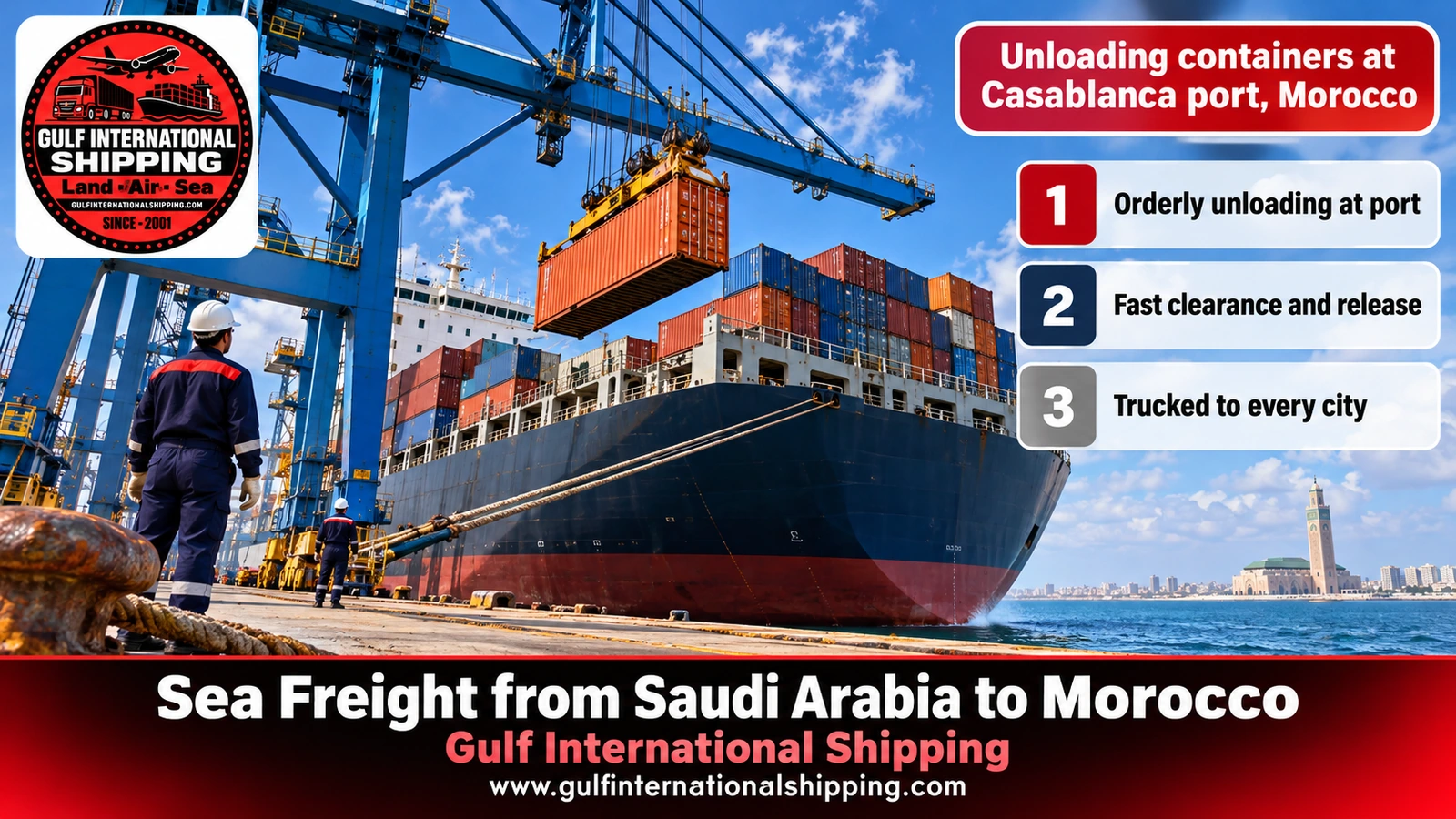
Casablanca port is the closest to Morocco’s economic capital and to Rabat, Marrakech, El Jadida and Settat, and boxes from Jeddah generally arrive there on a feeder vessel out of Tanger Med or another Mediterranean hub. The relay adds 3–7 days, but it saves a long truck run from the north for a heavy full container. Agadir port serves Souss-Massa and the south; we use it when a suitable service is on the schedule, otherwise cargo for Agadir goes by truck from Casablanca.
Shared sea freight (LCL): how is a cubic metre calculated?
In a shared box, the bill follows the volume your belongings occupy. Volume in cubic metres is length × width × height in metres for each piece or carton, added together. A medium carton of 60 × 40 × 40 cm is about 0.1 m³, so ten of them come close to one cubic metre, while a fridge measuring 70 × 80 × 180 cm takes about a cubic metre on its own. Our rate starts at SAR 780 per cubic metre.
The shared container is built up in our warehouse near Jeddah port and sails once it is full or on the weekly sailing, which is why shared freight can wait up to 7 days before it moves. In Morocco the shared container is unpacked in a bonded warehouse and each shipment is cleared in its owner’s name. Very small parcels are priced per parcel rather than per cubic metre, starting at SAR 110 for up to 5 kg; see cartons and parcels shipping to Morocco.
How to cut your cubic metres
Dismantle beds, tables and wardrobes, fill drawers and the empty fridge with light wrapped items, and use cartons in only two or three sizes so they stack without gaps. Each cubic metre you avoid is money you keep.
Full container (FCL): 20 ft or 40 ft?
With a full container the whole box is booked for your shipment, nobody shares it, and it is sealed after loading and not opened until Moroccan customs. That means fewer handlings, a sailing date that waits for no one else, and a lower cost per cubic metre the fuller the box. The table compares the common sizes:
Our working rule: once your goods exceed roughly 12–15 m³, compare with a 20 ft container, because its full price comes close to paying for those cubic metres in a shared box, with the advantages of a dedicated container. Above 33 m³, a 40 ft container is better value than two small ones. We price both options for you after the survey.
Sea freight prices from Saudi Arabia to Morocco
Every minimum below sits under the cheapest rate other Morocco shippers advertise for that item, and includes ocean carriage from the Kingdom plus ordinary packing. Duty and VAT that Moroccan customs charges on new goods or vehicles are paid to customs, not to us.
Note: the whole sea journey to the consignee takes 20–34 days, of which around ten are spent afloat between Jeddah and Tanger Med. Minimums are for Hejaz towns; Riyadh, Tabuk and Dammam add the cost of the truck run to Jeddah. For each city’s table see shipping prices from Saudi Arabia to Morocco.
Preparing a shipment for a long sea voyage
A container is a closed steel box, and on a voyage of several weeks it heats up by day and cools at night, so water vapour condenses on the roof and drips onto whatever is below. Shippers call this “container sweat”, and it is the main thing that ruins wooden furniture, cardboard and fabrics if it is not planned for. So we prepare sea shipments to Morocco differently from a short road move:
- Desiccant bags: hung on the container walls to absorb moisture before it condenses.
- A final sealing layer: wood and mattresses are wrapped in plastic over the bubble wrap and board.
- Wooden crates: for glass, marble, paintings and antiques, built to size and treated for export.
- Bone-dry appliances: fridges and washing machines are drained and left slightly open to dry before wrapping.
- Secured loading: heavy items at the bottom, pieces strapped, gaps filled so the load does not shift with the swell.
- Commercial goods on pallets: stretch-wrapped and marked with shipping labels.
Shipping a car to Morocco by sea in a container
Age comes first: an imported passenger car cannot be registered in Morocco once it is five years past its first registration, save for a few cases such as a returning retiree, who is usually allowed one under ten, so our containers only carry cars that meet the rule. The car goes to the port on an enclosed carrier, is fixed inside a 20 ft container with wheel straps and chocks, covered, and the container sealed. It must be empty of personal belongings, and its final export must be completed through Absher and the Fasah export declaration.
You pay us from SAR 4,600 to get the car to the Moroccan quay, then pay customs its duty and 20% VAT once it has valued the car, checked its tax horsepower and noted when it was first registered. In a 40 ft container the car can travel together with the household furniture. Full details are in car shipping from Saudi Arabia to Morocco.
Sea freight for commercial goods to Morocco
For traders and manufacturers we offer shared freight for small quantities and full containers for large ones: spare parts, equipment, packaging materials, packaged foods and e-commerce orders. Trade cargo travels with proof of origin, an invoice and a list of packages, and the importer in Morocco needs their trade registration and any product-specific licence. Moroccan duty is charged according to each item’s tariff line, and 20% VAT applies to most imports, so we advise the importer to check the tariff lines before shipping.
We also handle the reverse direction: the services that sail west from Jeddah return east from Tanger Med through Suez, so we collect from the exporter in Morocco, sail the box east to Jeddah, clear it under Saudi customs rules and truck it to your city.
Sea freight paperwork: export declaration and bill of lading
The first document in the journey is the export declaration filed on Saudi Arabia’s Fasah platform, which we prepare from a copy of your iqama or ID plus the packing details. After sailing, the carrier issues the bill of lading, the document proving the container is on board, naming the shipper, the consignee, the ports of loading and discharge and a description of the goods. In Morocco the container is released to the consignee named on it, so write their name exactly as on their national ID card.
Customs at the Moroccan port
On arrival our broker files the entry for the consignee and the customs office decides whether to open the box. A permanent returnee’s furniture is exempt if used and within the approved ceiling, with a change-of-residence certificate and detailed inventory, once per family; details are in Morocco returning residents’ household goods. New items and commercial goods pay duty plus 20% VAT. A complete file usually means release in two to five days.
Marine cargo insurance
Marine insurance covers the shipment against the major risks of the voyage, such as damage from an incident at sea, a container falling, or water ingress, according to the policy terms. The premium is a percentage of the declared value of the goods, which is why we ask for a list with approximate values. We recommend it especially for valuable furniture, cars and commercial goods, because a voyage across two seas and a canal, with handling in several ports, deserves that protection. Ask for an insurance quote together with your freight quote on WhatsApp.
Air freight as an alternative: when should you choose it?
Choose air freight to Morocco when the shipment is small and urgent or valuable: documents, prescribed medicines, a laptop, or spare parts a workshop is waiting for. Non-stop flights run from Riyadh to Casablanca and from Jeddah to both Casablanca and Rabat; Madinah has seasonal departures or connects through Jeddah, and parcels from Dammam, Taif or Tabuk join a flight in Riyadh or Jeddah. Around seven hours in the air plus airport clearance means delivery in three to seven days. The cheapest express parcel is SAR 1,655, and kilo rates are quoted from weight and dimensions. Many of our customers combine both: the container for the household, an air parcel for what they need in the first week. Details in air freight from Saudi Arabia to Morocco.
Tips to speed up sea freight and cut its cost
- 1Book two weeks ahead
so there is time to pack and file the export before the next vessel’s cut-off. - 2Choose the container on numbers
ask us to price shared and full together rather than guessing. - 3Prepare the consignee’s papers early
national ID and the change-of-residence certificate or invoices before the ship arrives. - 4Spell the consignee’s name exactly
as on their national ID, so a single letter does not hold up the container. - 5Avoid the summer peak
demand for Morocco rises when families travel home in summer, so book before it. - 6Split urgent from non-urgent
air for the few essentials, sea for the rest.
Book your space on the next container to Morocco
Share pictures or a cargo list plus the pickup and delivery towns, and we answer with a per-cubic-metre or per-box price and the closest sailing.
Related Morocco articles
- Shipping company from Saudi Arabia to Morocco, furniture moving to Morocco and shipping prices to Morocco
- Car shipping to Morocco, air freight to Morocco and returning residents’ household goods
- By city: Jeddah, Riyadh, Dammam, Makkah, Madinah, Taif, Tabuk
- International furniture moving, car shipping, customs clearance and request a quote