


Lebanon used household goods customs are zero for a Lebanese citizen returning home for good after more than three consecutive years abroad: used furniture and household effects enter duty-free once in a lifetime, provided the contents list is certified by the Lebanese embassy in Riyadh, the shipment arrives within three months of the owner entering Lebanon, and nothing is sold for three years. New or unused pieces pay customs duty by tariff line plus 11% VAT, and a car is not part of this exemption at all. Gulf International Shipping trucks returnees’ furniture to Lebanon from any Saudi city; a bedroom set starts at SAR 920, living-room furniture at SAR 1,100 and an entire home at SAR 3,680.
Many Lebanese families in the Kingdom know that “household goods are exempt”, but far fewer know that the exemption depends on timings and papers that must be in place before the truck moves, and that one slip, such as an uncertified list or a late flight home, turns your used furniture into an import that customs values and charges. This guide sets out the conditions one by one, explains which papers you prepare in Riyadh and which in Lebanon, what happens at Masnaa customs, and when you pay and when you don’t. The conditions below are those published in customs and embassy guidance; check them again before loading, because Lebanese customs may revise them.
At a glance
- Who qualifies: a Lebanese citizen returning permanently after more than 3 consecutive years abroad, once in a lifetime
- What is exempt: furniture and household items used for more than 6 months, forming a complete household rather than a few loose cartons
- Key document: the contents list, stamped by the Lebanese embassy in Riyadh, plus its statement confirming residence abroad and permanent return
- Deadlines: your goods must land within 3 months of the date you enter Lebanon, and stay unsold for 3 years
- What pays: new items pay duty by tariff line plus 11% VAT; a car follows a separate procedure
- Road transit: Tabuk 5–8 working days; Riyadh, Jeddah and Dammam 8–12; to the Bekaa and Beirut
- Prices: bedrooms start at SAR 920, whole households at SAR 3,680, clearance at SAR 276
Exemption: once only · 3 years abroad · 3 months to arrive · 3 years without selling · 0568829975
Is used furniture duty-free for Lebanese returning home?
No, provided you are returning to settle in Lebanon, have lived abroad for more than three consecutive years, and have never used this exemption before. The idea behind it is that someone coming home after a long stint abroad shouldn’t have their home treated as trade: the sofa the family sat on for years and the kitchen used every day are not new goods entering the market. Customs does, however, need proof of three things: that you lived abroad for the required period, that you are coming back to stay rather than to visit, and that the items are used and belong to your own household.
Because the exemption is granted only once in a lifetime, it is best used when you move the whole home rather than a handful of cartons. If you send a small part of your belongings now and claim the exemption on it, you may have no right left when the rest of the furniture follows, and small, incomplete consignments are usually treated as dutiable anyway.
Conditions for the returnee furniture exemption in Lebanon
Plan the flight and the truck together
The three-month window runs from the day you enter Lebanon, not from the loading date. So agree the loading date with us after you book your ticket, and the shipment reaches Masnaa while you are in Lebanon and inside the window. Road transit takes 5–12 working days depending on your city, so don’t put your flight off for weeks after loading.
Who doesn’t qualify for the used household goods exemption?
- Anyone abroad for less than three consecutive years: the goods are treated as an ordinary shipment and pay duty on their assessed value.
- Temporary returns: a long holiday, or a return with plans to go back to the Kingdom, does not count as permanent.
- Anyone who has used it before: the right is granted once, even if the first shipment was small.
- New items inside a returnee’s shipment: they are separated from the used goods and pay duty and VAT on their own.
- Quantities beyond one household’s needs: ten appliances of the same kind, for example, are treated as trade.
- The car: it is outside the furniture exemption, with its own age limits and procedure.
Documents: what to prepare in Riyadh and what to prepare in Lebanon
Half the paperwork comes from the Kingdom and half from Lebanon, and a gap in either half holds the shipment at Masnaa or costs you the exemption. Here is what each side requires:
How should the contents list be written before certification?
Write the list room by room, and for each room give the item, the quantity and its condition, for example: “Master bedroom: used double bed 1, used six-door wardrobe 1, used dressing table 1”, followed by the numbered cartons and roughly what each holds. Make every number on the list match a number written on a carton or piece, because that is exactly what the customs officer at Masnaa checks. Avoid “miscellaneous items” or “personal cartons” without detail, since vague entries invite a full inspection. The Gulf International Shipping packing crew writes this list with you while packing, and you then take it to the embassy for certification before the loading date. For embassy appointments and certification fees, contact the embassy directly, as it sets them itself.
What happens to your furniture at Masnaa customs?
The truck enters Lebanon at the Masnaa crossing in the Bekaa, where the papers are presented to Lebanese customs, the truck passes through the X-ray scanner, and the inspector asks to open whatever he wants to check. For a returnee’s shipment the inspection is usually by sample: the officer picks some cartons and pieces, matches them against the certified list, and confirms they are used. If he finds new pieces, he separates them and assesses their duty; if the list matches, the exemption decision is issued.
Being there yourself, or having a representative with power of attorney, speeds this stage up, and we attend the inspection and rewrap anything opened straight away before the furniture continues to your home. If some of your Lebanese papers aren’t ready on arrival, ask us before shipping whether a refundable bank deposit or temporary storage of the shipment until the papers are complete is possible; these options are at the discretion of customs and vary from case to case.

For the full picture of what happens at the border, from opening hours to truck queues and scanning, see our guide to the Masnaa border crossing.
When do you pay duty on household goods, and how much is VAT?
You pay when the exemption conditions don’t apply to you, or on the part of your shipment the exemption doesn’t cover. In that case Lebanese customs assesses the value of the goods, applies the customs duty for each item’s tariff line, roughly between zero and 30%, and then adds 11% VAT on the value plus duty. The most common cases are:
A point many people miss: if you buy new furniture or appliances made in the Kingdom and keep both the invoice and the origin certificate, customs duty on them may be waived under the Arab free trade agreement, leaving only VAT. Appliances imported from outside the Arab countries pay the full duty for their tariff line, even if you bought them from a Saudi shop.
The three-year no-sale condition
The exemption is not an unconditional gift: goods that entered duty-free must stay with you for at least three years. If you sell or give them away before then, customs may claim the duty you were spared, plus a fine of up to three times that amount. So don’t put anything you plan to sell after arrival into the exempt shipment; leave such items in the Kingdom or sell them before you travel.
Your car is not part of the furniture exemption
Lebanese customs does not treat your car as household goods, so the returnee exemption doesn’t cover it. Lebanon turns away passenger cars older than 8 years and any right-hand-drive vehicle, and it charges customs duty, excise and 11% VAT on a car according to its value and model year. We ship an eligible car on a carrier separate from the furniture, with a small car from SAR 2,300; the paperwork for that is in our separate car shipping from Saudi Arabia to Lebanon guide.
Packing that helps the inspector and doesn’t slow your shipment
Packing a returnee’s shipment has two jobs: protecting furniture on a long trip with several handlings, and allowing inspection without damage. So we wrap large pieces in layers that can be cut open on one side and rewrapped, tag every piece with its list number, and stack cartons in the truck with the numbers facing out. Valuables such as antiques, paintings and chandeliers go into numbered wooden crates, photographed before closing so the inspector doesn’t need to unpack them fully. Keep papers, jewellery and cash with you on the plane, not on the truck.
Items to think twice about before packing
- Small gas lighters and gas cylinders: banned in Lebanon or on the road load.
- Used medical equipment: Lebanon does not admit used medical and radiological equipment, so ask before shipping any home medical device.
- Old 900 MHz cordless phones: banned from import.
- Medicines: personal quantities with a prescription only.
- Food: a few tins for home use; larger quantities need approval.
- Swords, weapons and ammunition: prohibited, even as souvenirs.
- Any goods originating from Israel: prohibited, however small.
What a returnee’s move from Saudi Arabia to Lebanon costs
Gulf International Shipping prices for moving a returnee’s household start from the figures below; the second number is what the service usually reaches with a larger home, a more distant loading city or a farther Lebanese region:
Note: a returnee’s furniture usually takes 5–8 working days by road from Tabuk, or 8–12 from Riyadh, Jeddah or Dammam, to reach the Bekaa and Beirut, and add a day or two for the North and South. For single items: a dining table from SAR 365, a single bed, wardrobe, AC unit or washing machine from SAR 460, a fridge or sofa from SAR 550, and office furniture from SAR 735. Insurance depends on the value you declare, and we quote it on request. To compare every city, see Saudi Arabia to Lebanon shipping prices.
Air freight for what you need in the first days
Furniture travels by road, but some things can’t wait: the first week’s clothes, school papers, the laptop and family medicines. We fly these to Beirut from Madinah, Dammam, Jeddah or Riyadh, from SAR 32 per kg, and they reach the door within 3–5 days, subject to flight times and clearance. An air shipment is cleared at Beirut airport separately from the furniture, so ask customs how it will be treated if you want it included in your exemption claim, and keep a separate list for it. Weight-based rates and flights: check air freight from Saudi Arabia to Lebanon for those.
Steps to bring your furniture into Lebanon without duty
- 1Check your eligibility
Confirm your time abroad, that you haven’t used the exemption before, and that your return is permanent. - 2Book your ticket first
Fix the date you enter Lebanon, then we set the loading date so the shipment arrives within the three-month window. - 3Packing and the list
Our crew packs the home, numbers every piece and writes the list with you room by room. - 4Embassy certification
Take the list to the Lebanese embassy in Riyadh for certification with the residence and return statement. - 5Export and transit
We complete the Fasah authorisation, the truck exits through Al Haditha or Halat Ammar, and it passes Jordan, Nassib and Syria. - 6Prepare the Lebanese papers
Family civil extract, municipality-verified lease, mukhtar certificate, and your passport with the entry stamp. - 7Inspection at Masnaa
We attend the inspection with you or under your power of attorney; the exemption is issued, then we deliver and reassemble at home.
Delivery in Lebanon after customs
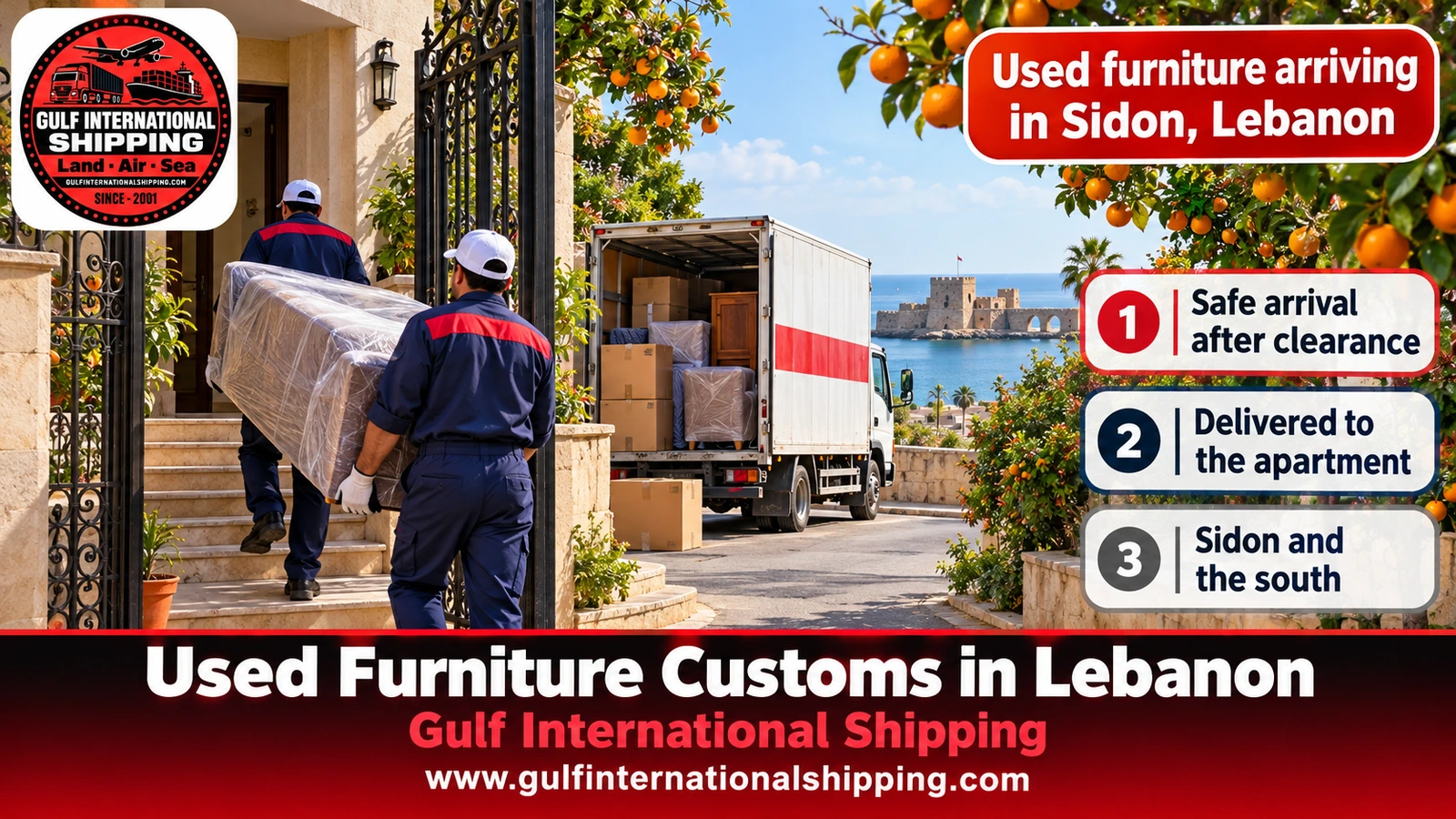
Once the exemption is granted, the shipment leaves Masnaa for the Bekaa first, then climbs to Beirut and Mount Lebanon and fans out to the North and South. We deliver in Zahle and Chtaura, every Beirut district, Baabda, Metn, Keserwan and Jbeil, Tripoli, Koura and Akkar, and Sidon, Tyre, Nabatieh and Marjayoun. Our team reassembles beds, wardrobes and the kitchen in place, clears away the packing, and you sign that the pieces match the list. For older buildings we ask in advance about the floor, the lift and the stairs, and arrange an external lift for large pieces if needed.
City-by-city transit times and prices are on our main page, shipping company from Saudi Arabia to Lebanon, while furniture moving from Saudi Arabia to Lebanon goes deeper into rooms and kitchens.
Mistakes that cost you the exemption or raise the duty
- Loading before the list is certified: a list not certified before shipping is no use afterwards.
- A vaguely worded list: “household items” without detail makes the inspection full and slow.
- Travelling late: the shipment arrives while you are still in the Kingdom, the window runs out, or the goods are treated as an import.
- Sending the home in instalments: the first instalment may use up your exemption.
- Mixing new appliances with used ones: they are separated and charged, and can hold up the whole shipment.
- Selling early in Lebanon: brings the duty back on you, plus a fine.
Start moving your home to Lebanon
Tell us your city, the number of rooms and your travel date, and we will send the cost and a loading plan that fits the exemption window.
Related Lebanon guides
- Shipping company from Saudi Arabia to Lebanon and furniture moving from Saudi Arabia to Lebanon
- By city: Riyadh, Jeddah, Dammam, Tabuk, Madinah
- Masnaa border crossing to Lebanon, car shipping to Lebanon, cartons and parcels to Lebanon
- International furniture moving, customs clearance, request a quote