
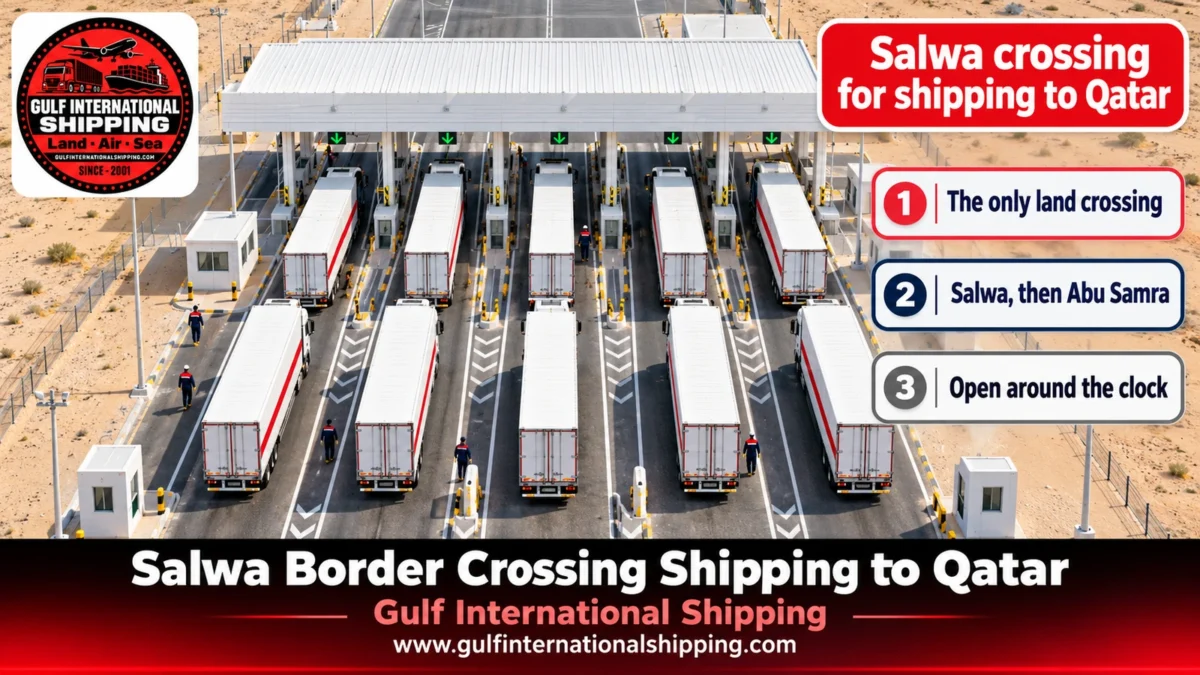
The Salwa border crossing is the only land route for shipping to Qatar from Saudi Arabia. You’ll find it at Salwa town (Al-Udaid Governorate), in the south-eastern corner of the Eastern Province; Abu Samra is the Qatari post opposite, and the gates never close. Every truck carrying furniture, cars or goods to Qatar passes through it, and Doha is about 90 km beyond. At Gulf International Shipping we enter your load in Fasah before the truck sets off, and our road prices start from SAR 7.5 per kilo of shared cargo, SAR 1,100 to move a sedan and SAR 138 to clear the load.
This guide looks at the crossing from the shipment’s point of view rather than the traveller’s: where it is, how a truck gets there from your city, what happens to your cargo on the Saudi side and then the Qatari side, which papers make the crossing quick, and why some trucks wait hours or even days.
In short
- Location: the town of Salwa in Al-Udaid Governorate, Eastern Province, near the Gulf of Salwa; the Saudi–Qatari border is only about 86 km long
- Qatari side: the Abu Samra crossing, about 90 km from Doha
- Opening hours: round the clock, all week, no weekly closure
- Authorities: the Zakat, Tax and Customs Authority and the Border Guard on the Saudi side
- Distance to Salwa: about 460 km from Riyadh and about 297 km from Dammam port (roughly 3 h 45 by truck)
- Charges in Qatar: normally 5% duty on non-GCC goods, and no VAT
- Our prices: shared-truck cargo from SAR 7.5 per kilo, suitcases from SAR 138, clearance from the same SAR 138
Route: Hofuf → Salwa (exit) → Abu Samra (entry) → Doha · Distance after the border: about 90 km · Contact: 0568829975
Where is the Salwa border crossing?
The crossing lies in the far south-east of the Eastern Province, in the town of Salwa, named after the bay beside it, and administratively part of Al-Udaid Governorate. The land border between Saudi Arabia and Qatar is short, about 86 km, and this is the only crossing on it. That is why Saudipedia lists it as the sole crossing between the two states, and why every overland route to Qatar, from any Saudi city, meets at one point.
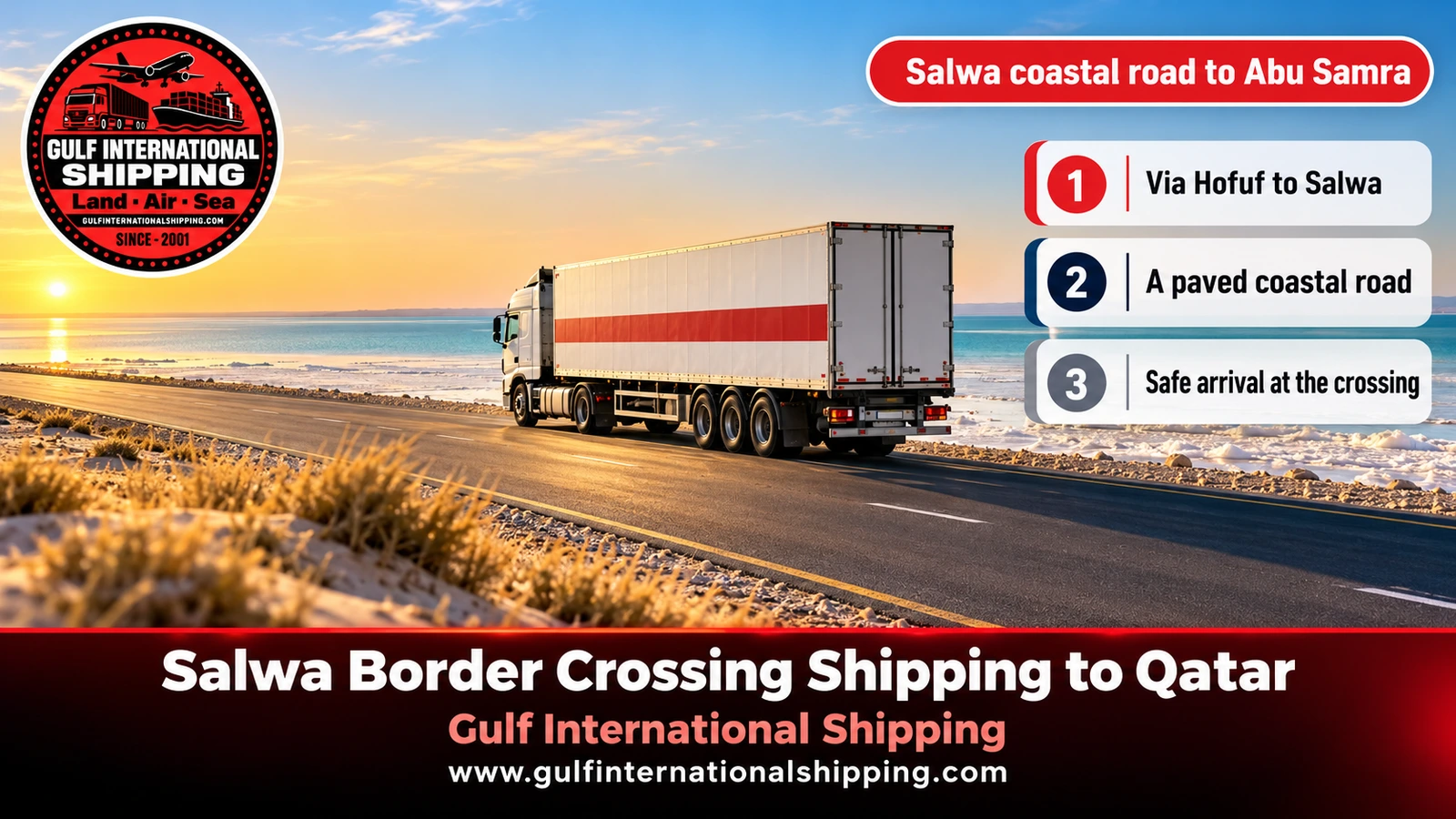
The road to the crossing runs through Al-Ahsa. Hofuf is the last large city before the border, and from there the road heads south-east across desert and coastal salt flats to Salwa. That explains why shippers talk about Hofuf so much when Qatar comes up: it’s the natural consolidation point for loads coming from Riyadh and the west, and the last stop before the frontier.
Is the Salwa crossing open 24 hours?
Yes. It runs day and night, all week, and the available data lists no holiday closures. In practice, a truck that arrives at night can cross at night if its papers are ready; seasons and holidays don’t stop traffic, though they can add queues. Gulf International Shipping uses this when scheduling: a truck from Riyadh may leave in the evening to reach the border at quieter hours.
The crossing’s passenger halls have been upgraded, and the Saudi and Qatari sides have held coordination meetings on traveller procedures and customs coordination for commercial traffic. The crossing was closed to passengers for a period and reopened after the GCC summit in Al-Ula; today it is the overland artery for freight between the two countries.
Getting to Salwa from Saudi cities
The table shows how trucks reach Salwa from each city, the approximate distance to Doha once across, and the door-to-door road transit times we work with:
Distances are rounded and shift with the road and pickup point; transit covers loading, both border posts and delivery. Each city has its own guide: Riyadh to Qatar, Dammam to Qatar and Jeddah to Qatar.
What happens to your shipment at Salwa?
Salwa is the exit point from the Kingdom, and what happens there depends largely on what was done before the truck arrived. This is the usual sequence for a Gulf International Shipping load:
- Before arrival: the load is entered in Fasah, ideally a day or so (about 24 hours) ahead of the border
- On arrival: the truck enters the freight lane, and the driver and broker match its papers to the filed data
- Inspection: the truck may be scanned or physically inspected, as customs decides
- Cars: export papers, export plates and owner details are checked before the car leaves
- Exit: once formalities are complete, the truck crosses to the Qatari side
A truck that arrives with its data filed and matching only waits its turn in the lane. A truck whose broker starts typing the declaration at the border can wait for hours. That’s the real difference between a carrier that knows the crossing and one that discovers it with your shipment.
What happens at Abu Samra on the Qatari side?
After leaving Salwa the truck enters Abu Samra, the entry point into Qatar and where Qatari customs formalities take place. Here the broker deals with Qatari customs through the Al Nadeeb electronic system:
- Broker registration: the authorised broker is registered on the declaration before the truck arrives; for personal shipments, the owner authorises them electronically using a Qatari mobile registered to their ID
- Customs declaration: the broker submits the declaration with the invoice or item list
- Inspection: some cartons may be opened and checked against the list, especially for furniture claiming the exemption
- Duty: any duty due is paid, normally 5% on goods of non-GCC origin
- Release: once released, the truck heads to Doha or its destination in Qatar
No VAT at Abu Samra
Qatar doesn’t apply VAT so far, so the only charge at entry is customs duty, where it’s due. Goods made in the Kingdom with a GCC origin certificate generally pass as local products, and a new employee’s used furniture goes free when its conditions are met.
Papers to have ready before the truck reaches Salwa
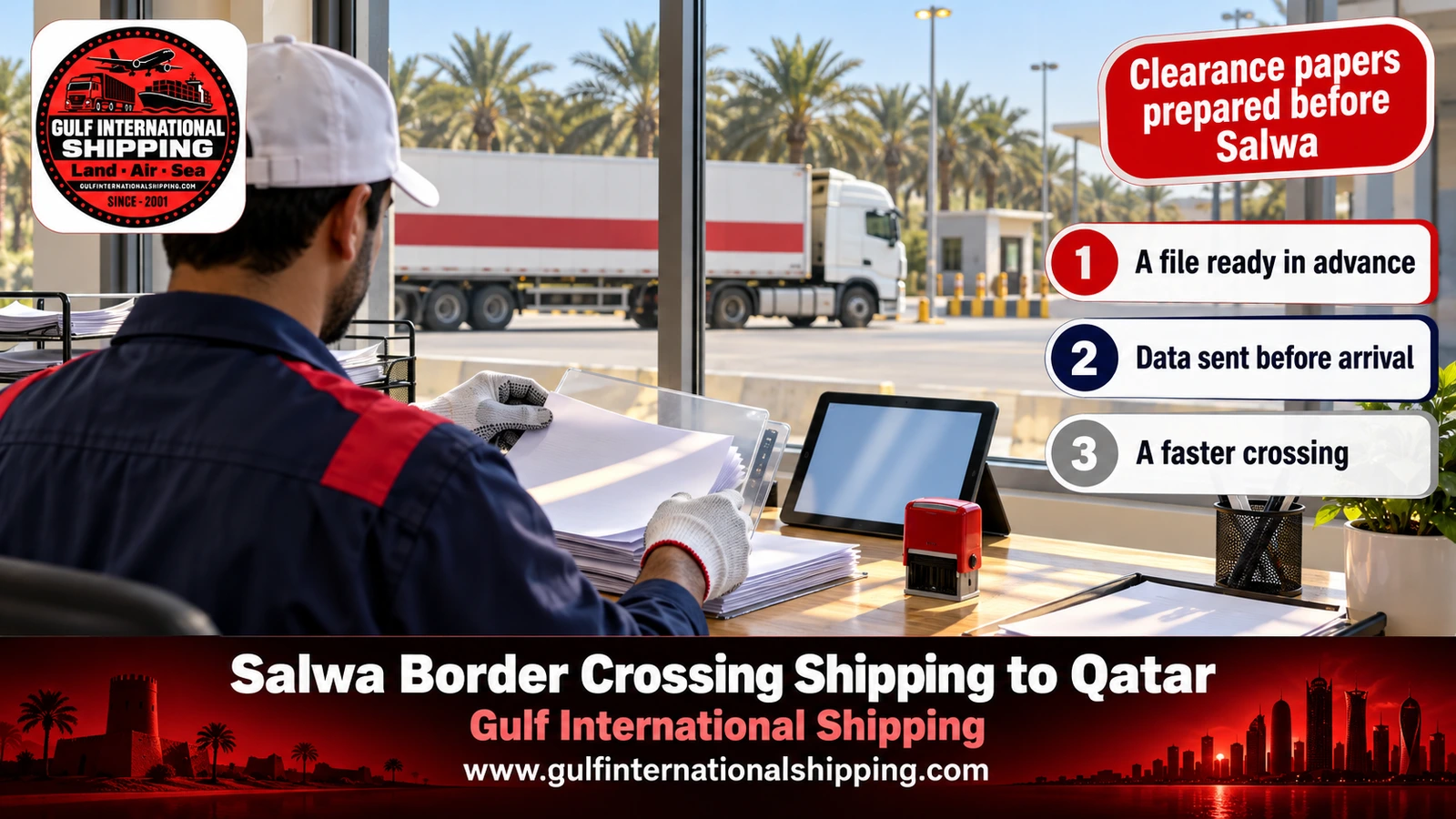
Complete paperwork is the single biggest factor in a quick crossing. Here’s a short list by shipment type; every customer gets their full list before loading:
The furniture papers and exemption rules are explained in Qatar used household goods customs, and car papers in our car shipping guide.
How long does it take to clear the Salwa crossing?
There’s no fixed crossing time; it depends on the shipment type, how complete the papers are and how busy the day is. What experience tells us: a shipment with pre-filed data and matching papers clears both posts within part of a day, while loads with a paperwork problem or an item needing approval are held. That’s why the transit times we quote include a margin for the border, and we say 2 to 4 days from Riyadh rather than exactly two.
Why shipments get delayed at Salwa and Abu Samra
- Data not filed in advance: the truck arrives and the broker hasn’t started on its declaration
- List doesn’t match the load: a different number of cartons, or items not on the list
- Banned or restricted items: e-cigarettes, medicines without a prescription, or food without a health certificate
- Car paperwork problems: unpaid traffic fines, a financed car without bank consent, or a car older than Qatar allows
- Broker not authorised: the owner hasn’t authorised the broker in Al Nadeeb or has no registered Qatari number
- Peak seasons: truck and traveller numbers rise before Eid and during holidays
A car that can’t enter Qatar comes back
A light vehicle more than five years old normally won’t be admitted, and neither will a car converted from right-hand drive, a flood car or one with chassis damage from a crash. Check before shipping; finding out at Abu Samra means a wasted trip.
Crossing Salwa with a car
Cars cross Salwa in one of two ways. Permanent export is for owners moving their car to register it in Qatar: the Saudi plates come off and export plates go on, a traffic export certificate is issued, the periodic inspection must be current, the fines record clean, and a financed car needs the lender’s go-ahead. On arrival Qatar takes 5% of the car’s value, and after a technical check it has to be registered within a fortnight. Temporary entry for visits needs a valid registration and a customs transit document.
Our car rates: a sedan from SAR 1,100 or an SUV from SAR 1,390 on the shared carrier, a luxury model from SAR 1,850 inside an enclosed transporter, and SAR 2,300 upwards for a private hydraulic flatbed. Cars travel empty of personal belongings, with a quarter tank of fuel, and are photographed from every side before loading.
Salwa is not Al-Batha
Some shipping websites mix up the eastern crossings. Al-Batha is the Kingdom’s crossing to the UAE and isn’t used for shipping to Qatar; Salwa is Qatar’s crossing alone. If a company tells you your Doha shipment will go via Al-Batha as an “alternative route”, either it doesn’t know the road or it plans to route through the UAE in an unusual way that adds days and paperwork. Always ask which crossing before you book.
Can you ship to Qatar without going through Salwa?
Yes, in two ways only. The first is air freight into Hamad International Airport, with delivery to the door in a day or two. Flights take under an hour from Dammam, around 90 minutes from Riyadh and close to 145 minutes from Jeddah. Our air prices start from SAR 41 per kilo (express parcels) and SAR 1,110 per cubic metre (furniture); see our air freight guide.
The second is the sea, available on request for traders’ containers between King Abdulaziz Port in Dammam and Hamad Port. It doesn’t suit furniture, cars or parcels, because the road through Salwa is shorter and delivers door to door, but it can work for a trader with a full container that isn’t urgent.
Road freight prices through the Salwa crossing
Starting prices for loads that cross into Qatar at Salwa:
Note: allow one to three days by truck from eastern cities, between two and four from Riyadh, and for the Hejaz cities three to five working days; by plane, a day or two.
Other frequently requested starting prices: consolidated freight SAR 7.5 per kg, a carton up to 30 kg SAR 120, a suitcase SAR 138, customs clearance SAR 138 and full villa furniture SAR 6,350. Everything else is on our full Qatar price list.
How your shipment crosses Salwa with us
- 1Booking
Send the shipment type, loading city and Qatari city on WhatsApp to 0568829975. - 2Document list
We send what’s needed on both the Saudi and Qatari sides and check it before loading. - 3Loading
We wrap, number and load the truck, and write the item list. - 4Data filing
Your load goes into Fasah ahead of the border while the broker is set up in Al Nadeeb. - 5Crossing
The truck exits Salwa and enters Abu Samra; we update you at each stage. - 6Delivery
After release, the shipment reaches your address in Doha or elsewhere in Qatar.
For the full service from every Saudi city, see shipping company from Saudi Arabia to Qatar; for trucks and load types, the land freight from Saudi Arabia to Qatar guide and our land freight service.
Your shipment crosses Salwa with its papers ready
Tell us what you’re shipping and from which city, and we’ll send the document list, the price and the next truck to Qatar.
Related articles
- Shipping company from Saudi Arabia to Qatar
- Land freight from Saudi Arabia to Qatar
- Qatar used household goods customs
- Car shipping from Saudi Arabia to Qatar
- Goods shipping from Saudi Arabia to Qatar
- Shipping from Dammam to Qatar
- All shipping destinations from Saudi Arabia