

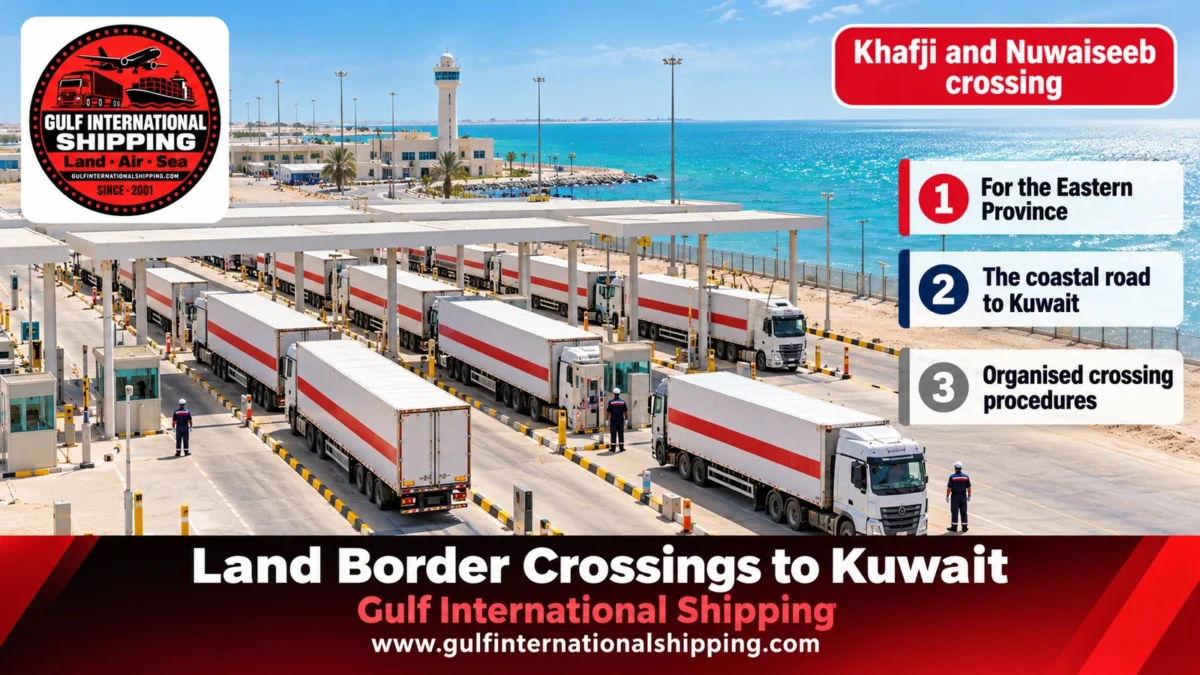
There are only two Saudi–Kuwait border crossings for shipping by road: Khafji, facing Nuwaiseeb on the coast, and Ruqai in Hafr Al-Batin, facing Salmi in Jahra. Loads from Dammam, Khobar, Jubail and Al-Ahsa usually cross at Khafji, while loads from Riyadh, Qassim, Jeddah, Makkah, Madinah and Tabuk cross at Ruqai. Every truck needs a Fasah appointment before it reaches the border. At Gulf International Shipping we choose the crossing based on your city and delivery area; consolidated cargo starts from SAR 2.75 a kilo, cars from SAR 1,100 on a shared carrier, and a whole truck from SAR 3,220.
This guide is for anyone who wants to understand what happens to their shipment between the last Saudi town and the first Kuwaiti one: where each crossing is, why your load uses one rather than the other, which papers the driver is asked for, when the queues build up, and which wrong names keep appearing online.
Quick facts
- Coastal crossing: Khafji (Eastern Province) → Nuwaiseeb (Ahmadi), about 3.5 km apart
- Inland crossing: Ruqai (Hafr Al-Batin Governorate) → Salmi (Jahra), stated capacity 2,000 trucks a day
- Land border length: about 222 km between Saudi Arabia and Kuwait
- Crossing requirement: a Fasah appointment booked before the truck reaches the port
- Door-to-door time: Eastern Province: 1–2 days · Riyadh: 2–3 days · western cities: 3–5 working days
- Prices: a kilo from SAR 2.75, a pallet from SAR 550, a sedan from SAR 1,100
Crossings: Khafji ↔ Nuwaiseeb · Ruqai ↔ Salmi · Contact: 0568829975
Khafji and Nuwaiseeb: the Eastern Province gateway
The Khafji crossing lies in Khafji Governorate in the Eastern Province, about 16 km from Khafji town, and Kuwait’s Nuwaiseeb crossing sits only about 3.5 km beyond it. From Nuwaiseeb the road enters the Nuwaiseeb area of Ahmadi Governorate, about 21 km away, then runs north towards Fahaheel, Mangaf and Kuwait City. On the Saudi side the crossing is operated by the Border Guard and the Zakat, Tax and Customs Authority, and it has been through development and expansion work.
This is the natural route for anything loaded in Dammam, Khobar, Dhahran, Qatif, Jubail or Al-Ahsa. Trucks take the Abu Hadriyah coastal road north to Khafji; the drive from Dammam to Kuwait City covers roughly 420 km, about five hours at the wheel. That is why Eastern Province shipments arrive door to door within one to two days. Many travellers also drive through it in their own cars, so it gets busy during holidays.
Ruqai and Salmi: the inland corridor for Riyadh and the west
The new Ruqai crossing in Hafr Al-Batin Governorate, Eastern Province, is the larger of the two. Its stated capacity is 12,000 vehicles and 2,000 trucks a day, it covers more than 6 million square metres, and it cost over SAR 1.6 billion to build. Opposite it on the Kuwaiti side is the Salmi crossing in Jahra Governorate, and the drive on from Salmi into Kuwait City takes 90 minutes to two hours.
Trucks from Riyadh reach it via Majmaah and Hafr Al-Batin; so do trucks from Qassim and Hail, trucks from Jeddah, Makkah and Taif passing through Qassim or Riyadh, trucks from Madinah via Qassim and, usually, trucks from Tabuk via Hail. In other words, nearly every shipment from central, western and northern Saudi Arabia converges on Hafr Al-Batin before crossing.

Khafji vs Ruqai at a glance
Neither crossing is “better” in absolute terms. The right one is whichever shortens the road from the loading city to the delivery address together. A truck going from Riyadh to Jahra has no reason to drop down to Dammam and then climb the coast, and a truck from Khobar to Ahmadi has no reason to cross the desert to Hafr Al-Batin.
Which crossing suits your shipment, by city and delivery area?
This table sums up our usual choice at Gulf International Shipping. Rows are the loading city; columns are the part of Kuwait where the shipment will be delivered:
There is one case where we bend the rule: small shipments heading to southern Kuwait may be grouped at our Dammam centre with other loads for Ahmadi and cross at Khafji. That lowers the owner’s cost but can add a day while the load fills up, so we give you both options before booking.
The Fasah appointment: what must happen before the truck arrives
A ruling by the Zakat, Tax and Customs Authority obliges the carrier, or whoever acts for it, to reserve a Fasah slot before a land transport vehicle gets to the customs port, and the vehicle has to turn up inside its slot, give or take roughly three hours. The rule applies at Khafji, Ruqai and every Saudi land border.
What does that mean for the shipment owner? The truck does not leave your city until its data is ready: type of goods, weight, sender and receiver details and the supporting documents. At Gulf International Shipping we upload that data and book the slot before loading, and we time the departure from your city so the truck arrives inside the appointment window. A truck that misses its slot may need a new booking, and that costs hours.
What this step needs from you
Before loading day: a clear contents list, your ID or iqama copy, and who will receive the goods in Kuwait with their mobile number. The earlier we have them, the better the slot.
What happens to the truck inside the two crossings?
Crossing from one country to another happens in two consecutive stages: exit from Saudi Arabia, then entry into Kuwait. This is the usual sequence:
- 1Arrival on the Fasah slot
The truck enters the Saudi port yard within its booked window. - 2Saudi exit formalities
The data filed on Fasah is matched, the truck and papers are checked, and the driver’s exit is stamped. - 3Moving to the Kuwaiti side
The truck covers the short gap between the two posts to Nuwaiseeb or Salmi. - 4Kuwaiti customs declaration
The clearing agent lodges the declaration and documents, and requests the exemption for used furniture where it applies. - 5Inspection and duty
The shipment is inspected if required, any duty is paid, and it is released. - 6On to the address
The truck heads to the Kuwaiti governorate for delivery.
On a shared load, several customers’ shipments are cleared on the same truck, so one customer’s missing paper holds up the whole truck. That is why we are strict about checking documents before loading rather than at the border.
Documents that travel with the truck

The receiver’s details in Kuwait matter as much as the sender’s papers: the name exactly as on the Civil ID and a working phone number. Products of Saudi origin travelling with a GCC origin certificate pay no duty, and Kuwait has no VAT, so the only payment at the Kuwaiti border is customs duty on goods that are not of GCC origin or not covered by an exemption.
Example: a furniture truck from Riyadh to Jahra
To see how these steps fit into a single journey, here is a family in a Riyadh neighbourhood moving their apartment to Jahra on a dedicated truck:
That is two to three days door to door, the figure we work to for Riyadh. On a shared load, the same shipment would take a day or two longer while other consignments are gathered; from Jeddah, add a day or two for the longer road to Hafr Al-Batin.
When do the Kuwait crossings get busy, and how we avoid waiting
Trucks cross both borders every day, but waiting times vary a lot. They usually rise on Thursday and Friday evenings, before Eid and school holidays, and on dusty, sandstorm days, which are common in spring; Khafji also fills with travellers’ cars in peak seasons. On quiet days formalities can be quick, while at peak times a truck may wait for hours.
- We book Fasah slots at quieter hours whenever possible, usually mid-week mornings.
- We time the truck’s departure from your city so it arrives within the window, not hours early.
- We check papers before loading so the truck is never held over a missing document.
- We warn you ahead of peak seasons so you can bring the shipping date forward if possible.
Cars at the border: permanent export or temporary entry?
A car crossing on a carrier is treated according to its purpose. If it will stay and be registered in Kuwait, it is a permanent export: the Saudi side requires export plates and an export certificate, paid-up traffic fines and, for financed cars, a bank release, and the chassis number is matched to the export declaration. On the Kuwaiti side, duty is 5%, and cars more than 10 years past manufacture, right-hand-drive cars and rebuilt or flood-damaged cars are banned; it is wise to confirm whether you can import it under your own name before shipping.
If the car is going into Kuwait for a limited period and coming back, it stays registered in Saudi Arabia and crosses with a triptyque (carnet) and insurance covering Kuwait. Prices begin at SAR 1,100 for a sedan travelling with other cars and SAR 1,660 on a hydraulic flatbed. Details in car shipping from Saudi Arabia to Kuwait.
Wrong crossing names that keep appearing online
Many pages about shipping to Kuwait mix up the crossing names. That is not a minor slip: a company that does not know the crossing will not know the real transit time or cost either.
Road freight prices through the Kuwait crossings
Gulf International Shipping charges the same whether a shipment crosses at Khafji or Ruqai; what changes the price is the loading city and the size of the load. These are our starting rates, set below what competitors publish for the Kuwait route:
Note: via Khafji, Eastern Province loads arrive within 1–2 days; via Ruqai, Riyadh loads arrive within 2–3 days and western loads within 3–5 working days; air freight arrives in 24–72 hours depending on flights.
Commercial cargo by the kilo starts from SAR 2.75, and a 20-foot box moved by truck from SAR 3,220. All rates are on shipping prices from Saudi Arabia to Kuwait.
Find the right crossing and price for your load
Send your loading city, the Kuwaiti area and the type of shipment, and we will tell you the best crossing, the price and the crossing date.
Air freight: when you do not want to wait for the road
Some shipments cannot afford two or three days on the road plus a border queue: official documents, spare parts for a stalled machine, permitted medicines. For these we use air freight. Air time from Dammam is about an hour; from Riyadh, roughly 80 minutes; from Jeddah, near two hours; with door-to-door delivery in 24–72 hours as flights allow. We lock in the flight and space when you book and price by weight and volume, so send the details and we will quote. With no early space, the road from Dammam through Khafji delivers within 1–2 days. Details in air freight from Saudi Arabia to Kuwait.
Shipping from Kuwait to Saudi Arabia through the same crossings
Both crossings work in both directions. A shipment leaving Ahmadi or Fahaheel for the Eastern Province crosses Nuwaiseeb then Khafji, and one leaving Jahra or the Capital for Riyadh and the west crosses Salmi then Ruqai. Paperwork on the Saudi side depends on the shipment type and the owner’s status, so tell us what you are moving and we will handle the formalities.
Related guides
- Shipping company from Saudi Arabia to Kuwait
- Land freight from Dammam to Kuwait
- Shipping from Riyadh to Kuwait
- Shipping from Jeddah to Kuwait
- Shipping from Tabuk to Kuwait
- Kuwait used household goods customs
- Goods shipping from Saudi Arabia to Kuwait
- Land freight service
- Customs clearance service